Katie from one of my favorite vegan blogs, Chocolate Covered Katie, announced today that she is going to host an online bake sale to raise money for disaster relief in Japan. She grew up in Japan so this cause is near and dear to her heart. I imagine we have all been touched by the disaster in one way or another, and I’m no exception. I have a good friend that lives in Japan, and also have a co-worker whose family lives there, and while all of them came out OK, my heart goes out to those who are suffering from loss and devastation because I know how easily it could have affected someone that I loved.
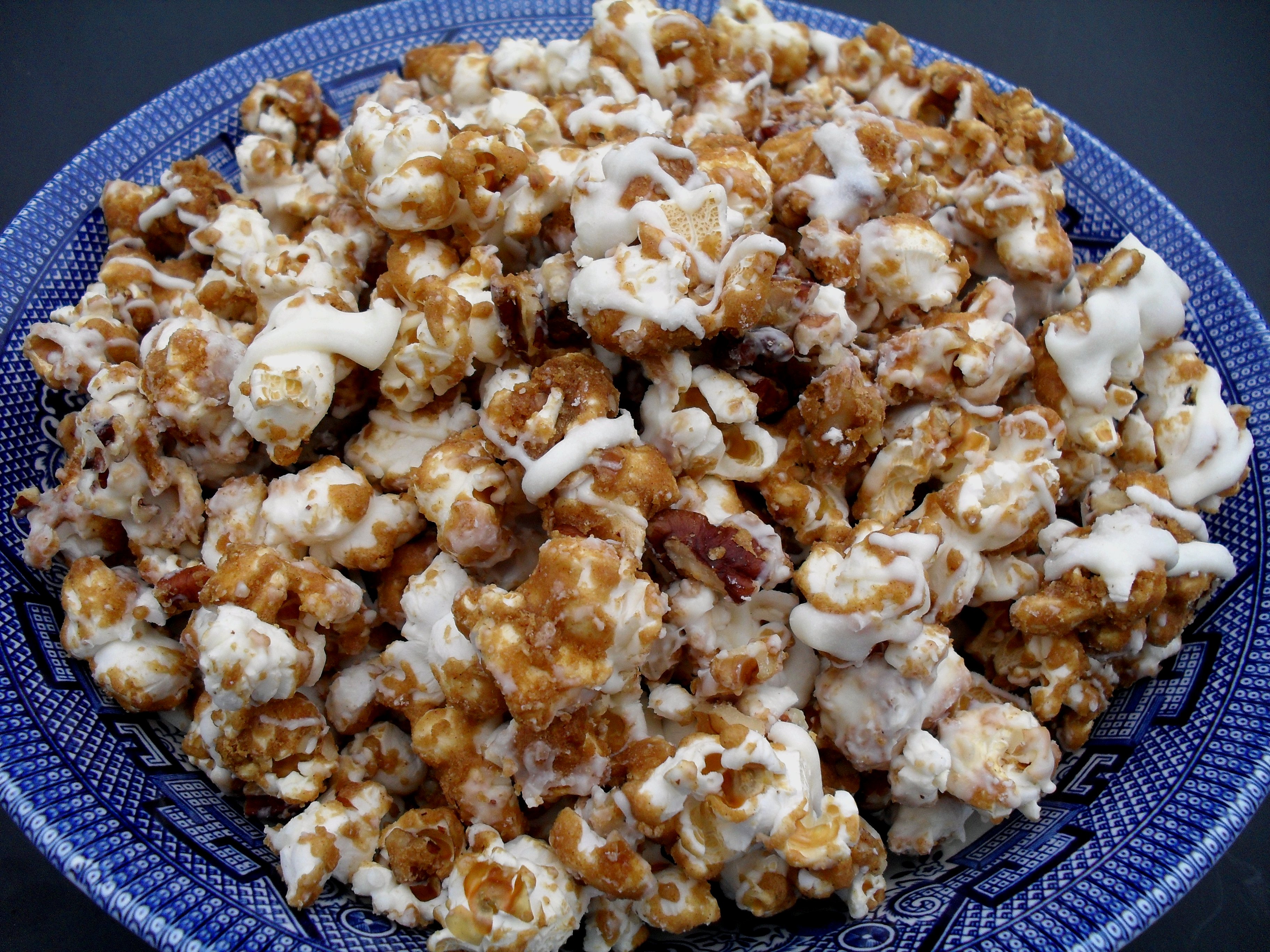
I had so much fun participating in Stephanie’s bake sale for the Leukemia and Lymphoma Society, so I immediately started brainstorming about what I could donate to Katie’s. I only have two vegan dessert recipes on my blog (Mounds Cake and Black Rice Pudding), and neither would travel very well, so I opted to make something else that would. Caramel corn! I took my favorite Cinnabon Caramel Corn and turned it vegan and I have to say, it’s scrumptious! I will be offering a full gallon-sized bag of it for Katie’s bake sale on April 5th. I will give another announcement the day of the bake sale so you can stop by to bid or see if there’s anything else there you’d like to bid on and help raise money for Japan. If you’d like to donate a vegan baked good, click here to check out the details.
½ cup popcorn kernels or about 12 cups popped corn
½ cup roughly chopped pecans
½ cup roughly chopped walnuts
½ cup Earth Balance
1 cup packed light brown sugar
¼ cup light agave nectar or light corn syrup
1 1/2 teaspoons cinnamon
½ teaspoon salt
½ teaspoon baking soda
1 teaspoon vanilla extract
6 ounces vegan white chocolate, roughly chopped*
1 tablespoon coconut oil
Preheat oven to 200 degrees. Use an air popper to pop corn into a large bowl. Fish out any unpopped kernels, then sprinkle the nuts over the top and set aside. In a large saucepan, melt the Earth Balance over medium heat; stir in the brown sugar, agave nectar, cinnamon & salt. Bring to a boil while stirring constantly (I increase heat to medium-high to achieve this faster, then reduce heat back to medium once it’s boiling), then allow to boil for 4 minutes without stirring. Remove from heat and stir in soda and vanilla (mixture will bubble up and become foamy). Pour over the popcorn and stir well to coat. Spread out on a large rimmed baking sheet and bake in preheated oven for half an hour, stirring halfway through baking time. Remove from oven and scatter onto waxed paper-lined cookie sheets. Place white chocolate and coconut oil in microwave safe bowl and heat for 30 seconds; stir. Heat in 15-second intervals, stirring in between, until smooth. This should only take 1-2 times. Using a spoon, drizzle chocolate over the popcorn and put in refrigerator for ten minutes or until chocolate is firm. Break into pieces and store in an airtight container or Ziploc bags.
*If you can’t find some sort of dairy-free, vegan white “chocolate” in your area, it is available for purchase online or you can make your own. I used this recipe. If you use homemade vegan white chocolate, do not melt it (it becomes too liquid and won’t coat the pieces very well). Instead, chop fine and once the caramel corn is spread on waxed paper lined cookie sheets, scatter it over the top so that the heat from the caramel corn will melt it. Place the sheets in the refrigerator as soon as the chocolate is on top to keep it from melting too fast or it will drain to the bottom instead of staying on top.
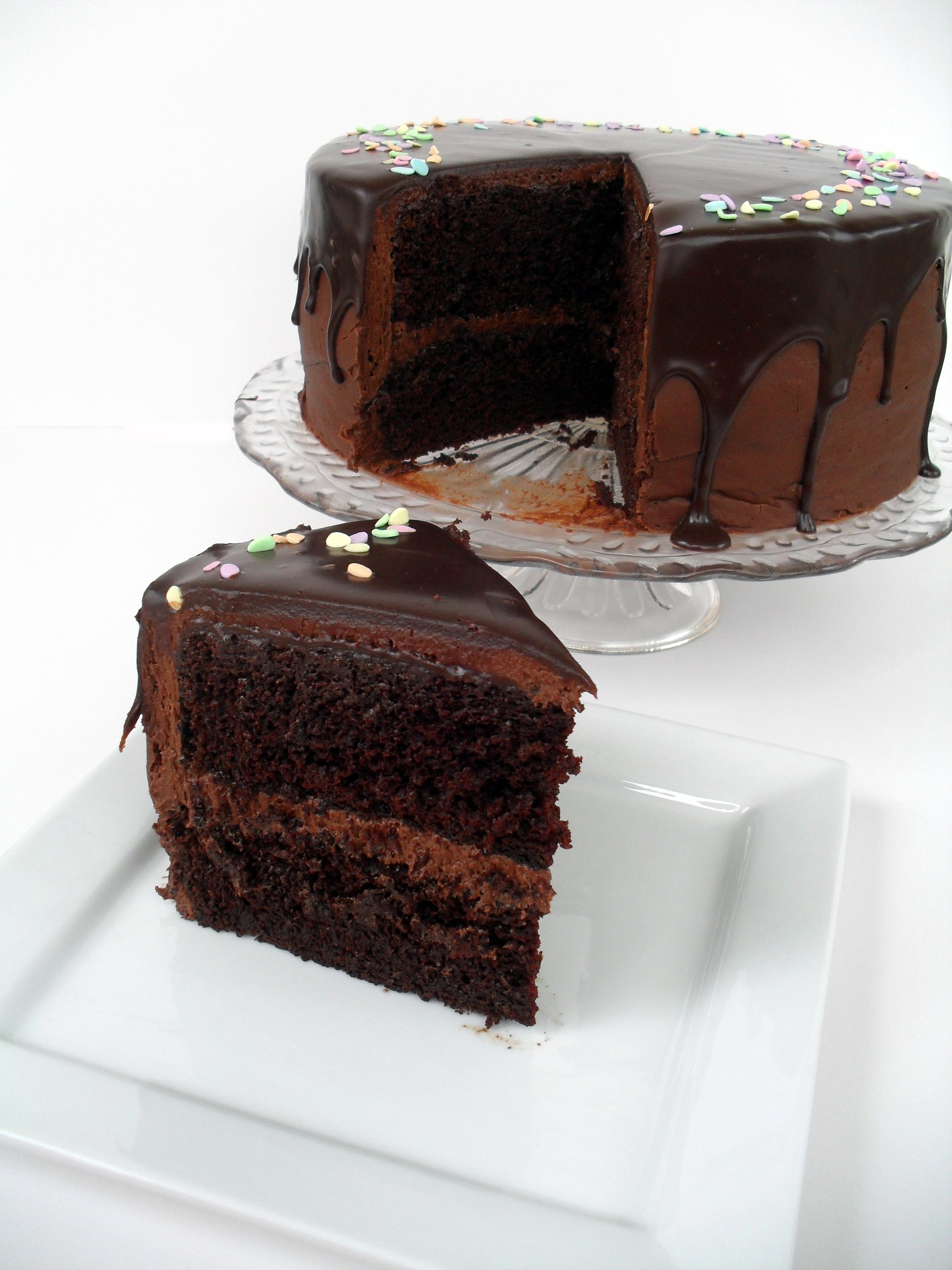
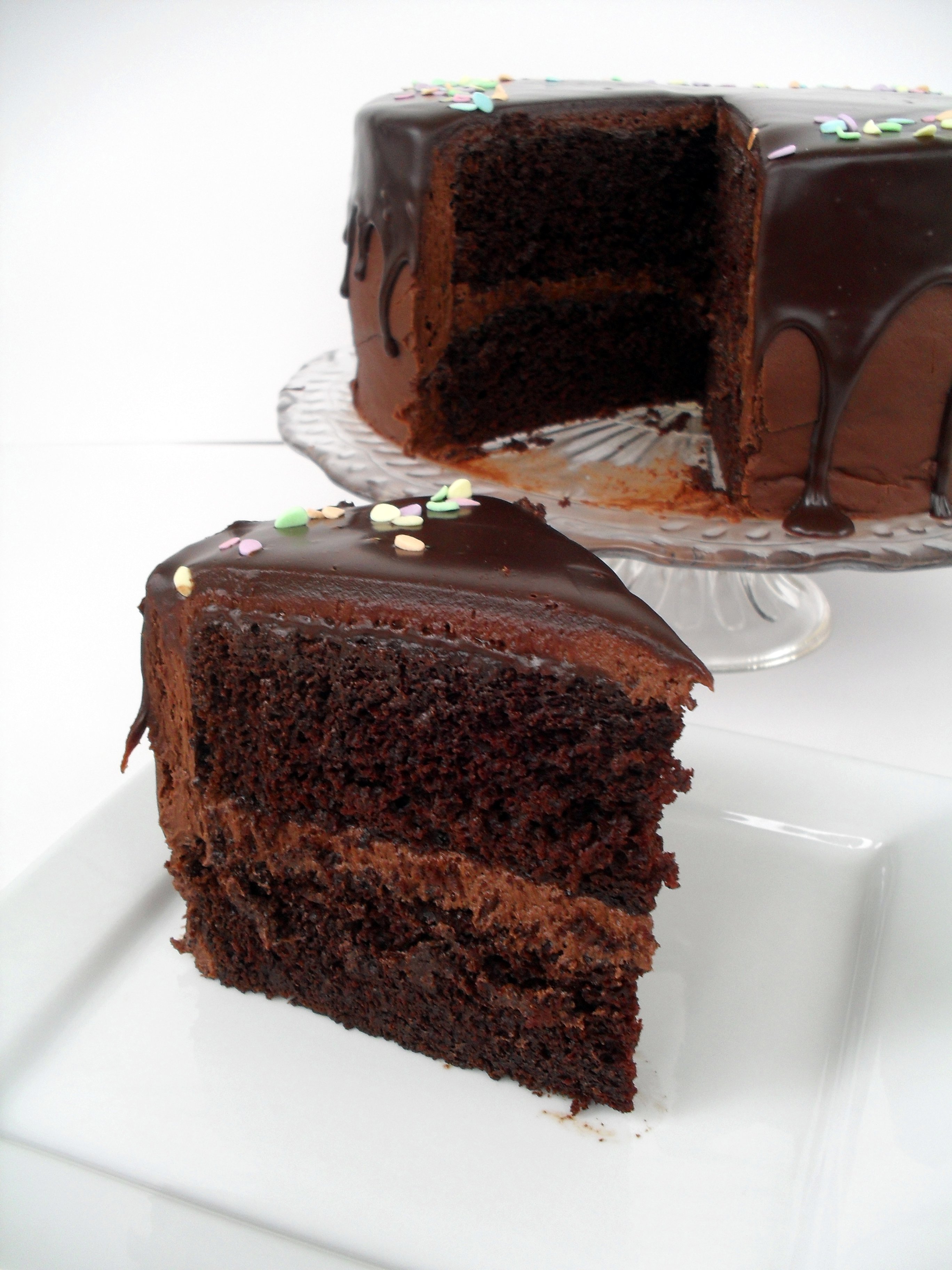
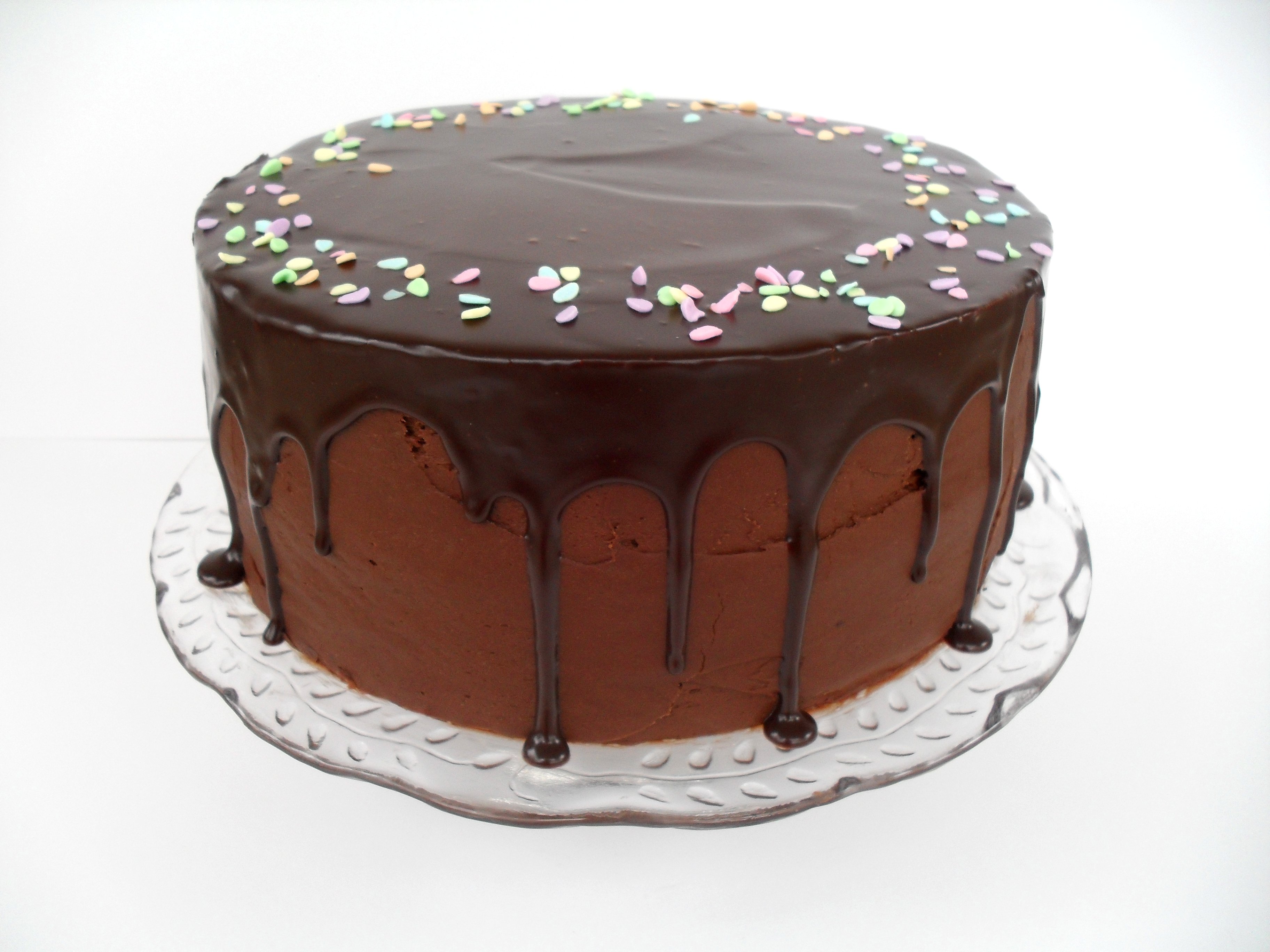
I’ve made several tiered cakes over the last few years (you can see them all here), but a friend’s surprise 40th birthday party last November was my first opportunity to do a really decadent chocolate one. Needless to say, I was extremely excited to try something new!
With my husband, left, and the birthday boy at his party
If I had to pick a single type of cake to eat for the rest of my life, it would be white with cream cheese wedding frosting, but if you are a chocolate lover, this is the cake for you. I know I tend to be quite effusive over most of my cake recipes (I’m effusive by nature, and I can’t help it–my cakes are the bomb! I kid, but really. They are. :) ), but I can tell you that this is the cake that I have gotten the most positive feedback for. That may be in part due to the number of people I served it to, since most of my cakes are only made for groups of about 10 people, but I do think this is probably the best chocolate cake I have in my repertoire, and I have made it several times since the birthday party to great reviews as well. It is my husband’s all-time favorite cake, and although it isn’t my favorite cake, it is my favorite chocolate cake.
If you are thinking about making a tiered cake in the future, but are intimidated, I highly recommend the method I used for this particular cake. If you frost each cake on top of a thick, foil covered cake board that is at least 2″ larger in diameter than the cake itself, then insert four hidden pillars into the bottom two tiers, all you have to do is transport the cake in three tiers to the location where the cake will be set up, and plop each cake on top of the pillars. And you’re done! With the usual way I do it (you can read about that process here), the stress level is considerably higher and there is more chance of messing up the cake. It is almost impossible to mess it up using hidden pillars.
*Hidden pillars aren’t actually invisible, as you can see, but since they are tall you can insert them down into the cake so that each tier is supported from the base of the cake below it. It is the part of the pillar inserted to the cake that is hidden.
Another tip is that once the cakes have been removed from the refrigerator to come to room temperature, make sure they have a way to breathe. After inserting the pillars in the bottom two, you don’t have to worry about them. But you should insert a hole with a skewer through the top of the top tier as well, or choose a place on the least attractive side of the cake (the one you’ll face to the back of the room) to poke a hole into each layer of the cake. This is to prevent air pockets from forming underneath the icing. This is a problem that cake decorators face across the world, and according to the professionals I have consulted, no one knows why it happens. When I make real buttercream with eggs and no powdered sugar, this never happens. So I suspect it has something to do with a reaction between the cake and the powdered sugar frosting on the surface. So if you are using a powdered sugar frosting (aka American buttercream), please make sure there is a place for air to escape so that your frosting job will not be ruined. (I used to be concerned this would make the cake dry out, but an entire day with a hole poked in the cake does not seem to affect it at all. If I’m making the cake 2 or more days in advance, I keep it in the refrigerator to keep it fresh and to keep air bubbles from forming beneath the frosting, and then poke it before I take it out to come to room temperature.)
UPDATE: It has now been explained to me that when you frost a cake cold and refrigerate it, once you bring it to room temperature the air inside the cake expands, causing the icing bulge, aka “icing budge.” While this is the most likely explanation, I have actually had the bulge happen when frosting room temperature cakes and never refrigerating them. So weird!
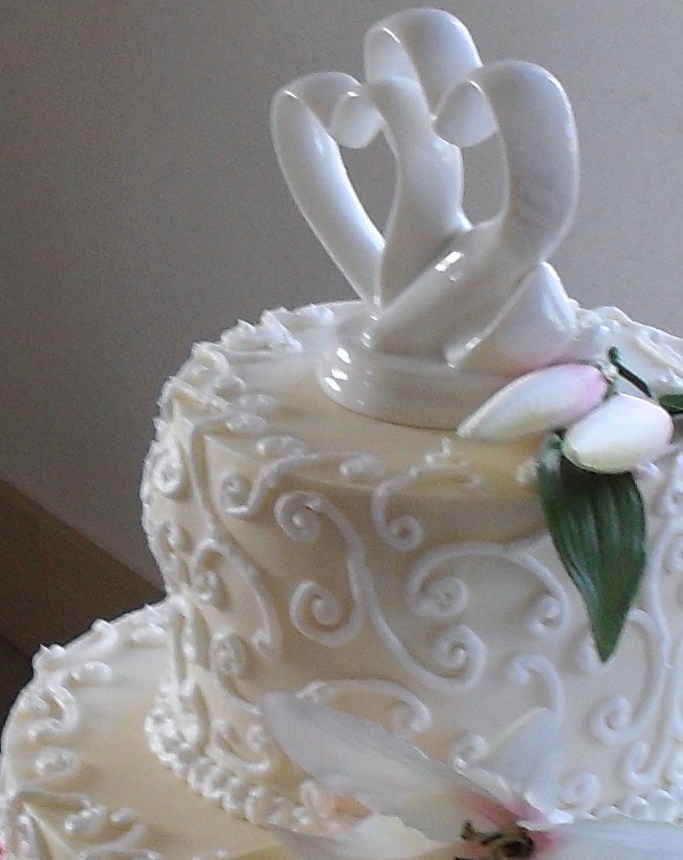
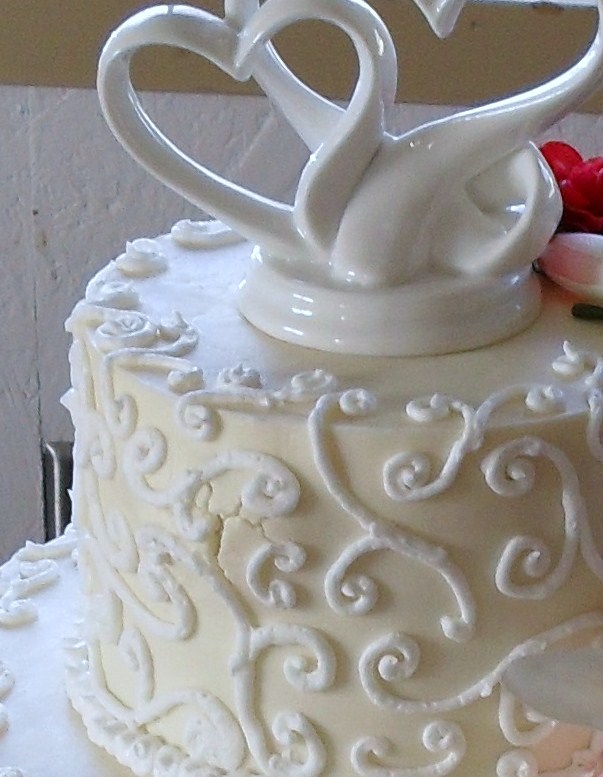
Here are some pictures of icing eruptions that have happened to my cakes before I figured out I needed to poke them so they could breathe:
You can see the bump on the left side where air or gas is trying to escape.
And this is the view straight on. The bottom two tiers of this cake never gave me any trouble, but the top tier didn’t have dowel rods in it so there was no way for it to breathe and I had to fix probably 10 of these eruptions!
This has been such a pain for me, that I even caught one of the incidents on video! This was before I figured out I needed to poke the cake to prevent the air pockets.
A tip for getting your frosting perfectly smooth is to spray the cake with water after smoothing it out as much as you can with an offset spatula, then going over it again with a clean spatula. The water helps your spatula to glide over the surface and make it very smooth. You can also dip your spatula in water, but I find using a squirt bottle to apply it makes the job much faster.
OK, let’s get to my favorite chocolate cake recipe! I took a bunch of photos of my latest one so I included a few extra for you at the end of the post. You’re welcome. :)
Favorite Chocolate Cake
This recipe makes one 9″ two-layer cake. To make a tiered cake the size pictured above, you’ll need to make about 7 batches of the cake recipe (2 batches for each 14″ layer, 1 batch for each 10″ layer and less than 1 recipe for both 6″ layers combined), 5 batches of the frosting, and 5 batches of the glaze. Printable recipe Printable recipe with picture Printable recipe for cake only
Favorite Chocolate Cake
1 ¼ cups unsweetened cocoa powder
2 ½ cups all purpose flour
2 ½ cups sugar
2 ½ teaspoons baking soda
1 ¼ teaspoons baking powder
1 ¼ teaspoons salt
2 large eggs plus 1 large egg yolk
1 ¼ cups warm water
1 ¼ cups buttermilk
½ cup plus 2 tablespoons vegetable oil
1 ½ teaspoons pure vanilla extract
Favorite Chocolate Frosting
2 sticks unsalted butter, room temperature
½ cup vegetable shortening
2 oz semisweet chocolate, melted and cooled
1 cup unsweetened cocoa powder
¼ cup dutch-process cocoa powder
¼ teaspoon salt
2 lbs (8 cups) powdered sugar
¾ cup milk
2 teaspoons vanilla
Favorite Chocolate Glaze
½ cup heavy cream
4 oz semisweet chocolate, chopped
2 teaspoons corn syrup
½ teaspoon vanilla
Make the cake: Preheat the oven to 350 degrees, making sure the baking rack is in the middle of the oven. Prepare two 9” round cake pans by cutting out a piece of parchment or wax paper to line the bottom of them. Grease the pans, place the parchment or wax paper in the bottoms and lightly grease again. Dust the pans with flour (or cocoa powder if you don’t want the white dusting on the finished cakes). Set the pans aside.
Sift together the cocoa, flour, sugar, baking soda, baking powder, and salt into a large bowl. Add the eggs, yolk, warm water, buttermilk, oil and vanilla. Mix on low speed until smooth, about 3 minutes.
Divide the batter evenly between the prepared pans. Bake the cakes for about 35 minutes, until a toothpick inserted into the middle comes out clean or with moist crumbs. Do not overbake! Remove the pans from the oven and set the pans on a wire rack to cool for 15 minutes. Gently run a thin knife around the edges of the pans and unmold the cakes, removing the parchment paper liners from the bottom of the cakes. Let them cool completely, top sides ups, on a wire rack. Trim the tops of the cake layers with a long serrated knife to make them level.
*Veronica’s notes: Although I have never had a problem with this cake recipe overflowing in my pans, many people have left comments on Melanie’s blog (and once on mine when I used it before for THE Mocha Crunch Cake) that they did, so I recommend either making sure the batter is no more than 2/3 full in your pans or placing a baking sheet below the pans to catch any overflow, just in case. If you have extra batter, make a few cupcakes! Also, please do not skip lining the pans with parchment or waxed paper. This cake is sticky and I learned the hard way that it will stick to the pan even if you grease and flour it.
Make the frosting: Cream butter and shortening together until smooth. Beat in melted chocolate until smooth. Add the cocoa powders, salt, sugar and milk to the bowl and turn the mixer to a very low setting until it’s combined enough to increase the speed. Continue increasing the speed and scraping the sides of the bowl until everything is incorporated, then add the vanilla and continue beating until fluffy. Frost cooled cake and freeze leftovers. This makes a large batch so unless you lay the frosting on super thick, you should have enough leftover to frost a dozen cupcakes, but the batch isn’t quite large enough to cut in half. I know, I make things difficult, but you won’t regret having some extra on hand.
Make the glaze: Gently heat the cream and chocolate together in the microwave or in a double boiler, stirring often until smooth and shiny. Stir in the corn syrup and vanilla. Allow to come to room temperature before pouring over the top of the cake and spreading to the edge with a spatula so that it drips over the sides. If the glaze gets too thick, heat it again for a few seconds (it won’t take long) and stir before pouring over the cake. Serve the cake at room temperature.
Recipe source: cake recipe from My Kitchen Cafe, frosting and glaze by Veronica Miller.
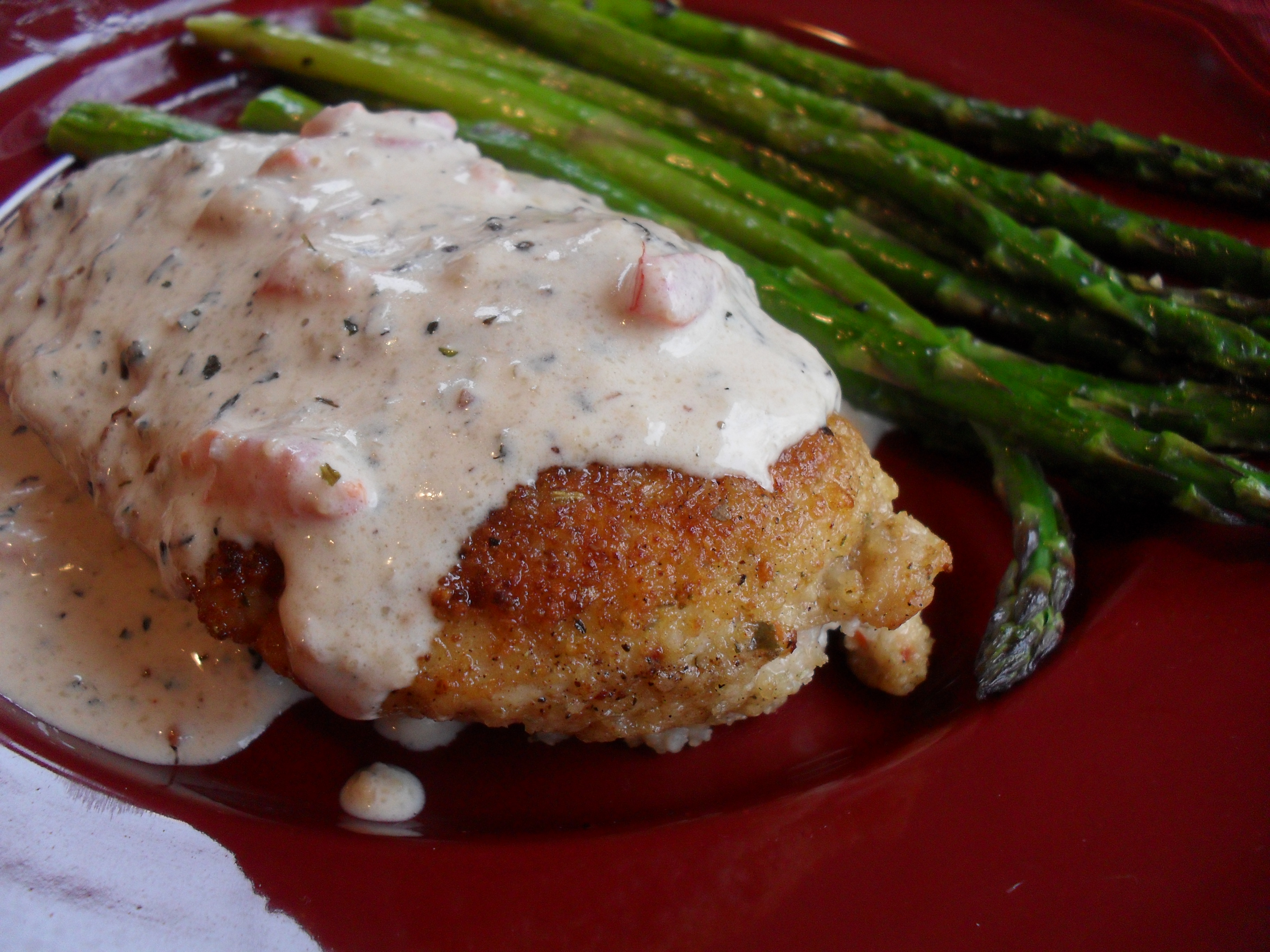
My friend, Suzie, shared this recipe on Facebook a while back, and while alltherecipes I’ve tried from her rock, this was one I never intended to make. I make it a rule to shun or lighten all recipes that call for more than a tablespoon or two of heavy cream (except in desserts, of course!), but I recently went through a low-carb phase and ended up making a lot of yummy rich dishes during the two weeks I masqueraded as a carnivorous beast. I’m usually not a big fan of meat in general, but my husband (the true carnivore between us) and I both loved this dish.
I have to say, the coating (a Suzanne Somers recipe) I used in place of flour on the chicken was tremendous. I made extra so I could use it again because I’m imagining it encrusting pieces of white fish and think it would be great on any cut of meat. It has tons of flavor. Of course the basil cream was incredible, and a very good compliment to the flavor of the “breaded” meat. One portion of this dish is satisfying enough that you shouldn’t need anything else besides some roasted asparagus or a salad…but if you don’t have to worry about your caloric intake, I hate you I think this would be great over linguine!
Although the low-carb phase was temporary, it reminded me that fat is not the enemy and can be included in my dietary plan, even in large amounts if I reduce calories in other ways, such as serving vegetables alongside this chicken instead of pasta and bread. It is definitely worth scrimping on the carbs in order to enjoy a meal like this every so often!
Bake & Fry Mix
1 cup minced onion
1 teaspoons salt
1/4 teaspoon black pepper
1/4 teaspoon ground sage
1/2 teaspoon dried rosemary
1/2 teaspoon dried coriander
1/2 teaspoon dried thyme
1/4 teaspoon dried oregano
1/4 teaspoon paprika
1/4 teaspoon red pepper flakes
1 bay leaves, crushed
1/2 cup grated Parmesan cheese
Chicken and sauce
8 (4 oz) boneless, skinless chicken breasts
1 stick (1/2 cup) unsalted butter
1 cup chicken broth
2 cups heavy whipping cream
1 (4 oz) jar sliced pimentos, drained
1 cup grated Parmesan cheese
2 tablespoon dried basil
1/4 teaspoon pepper
Place minced onion in food processor fitted with blade attachment. Process one minute. Add remaining mix ingredients, except the cheese, and process another minute. Add cheese and pulse until combined. Place in a gallon-sized Ziploc bag. Add chicken to the bag and shake until every piece is coated. On medium-high heat, cook chicken in butter on both sides until juices run clear, about 10 minutes. Remove and keep warm. Add broth to the skillet. Bring to a boil over medium heat; stir to loosen browned bits. Stir in the cream, pimientos and basil; boil and stir for 1 minute. Reduce heat. Add the Parmesan cheese and pepper; cook and stir until heated through. Pour over the chicken and serve.
Makes 8 servings. Per serving: 544 calories; 41 g fat; 2.5 g carbohydrates; 0 g fiber; 36 g protein
Recipe source: adapted from Fast & Easy by Suzanne Somers and Suzie S.
Before we get to some major Indian yumminess, I wanted to mention two things. First, you may notice things look a bit different around here. I changed my theme and I like it but I’m not sure it’s “the one.” I think the header is very plain…but I’m cheap and I don’t want to pay to get fancy so this is probably as good as it gets. :) Let me know what you think!
Second, I think I caused some confusion with my post on the cake decorating competition at work. I’m not sure how many of you saw that, but I wanted to clarify that the date on it is correct. I wrote it two years ago on my MySpace blog, and newly copied it to Recipe Rhapsody so that I could link to it in reference to how to make a tiered cake in an upcoming post. I posted it with the original date I wrote it, so I didn’t think any one would see it, but I started getting some comments on it so apparently it came across some of your radars! Just wanted to clarify that it’s now old news, but I appreciate your kind words and congratulations.
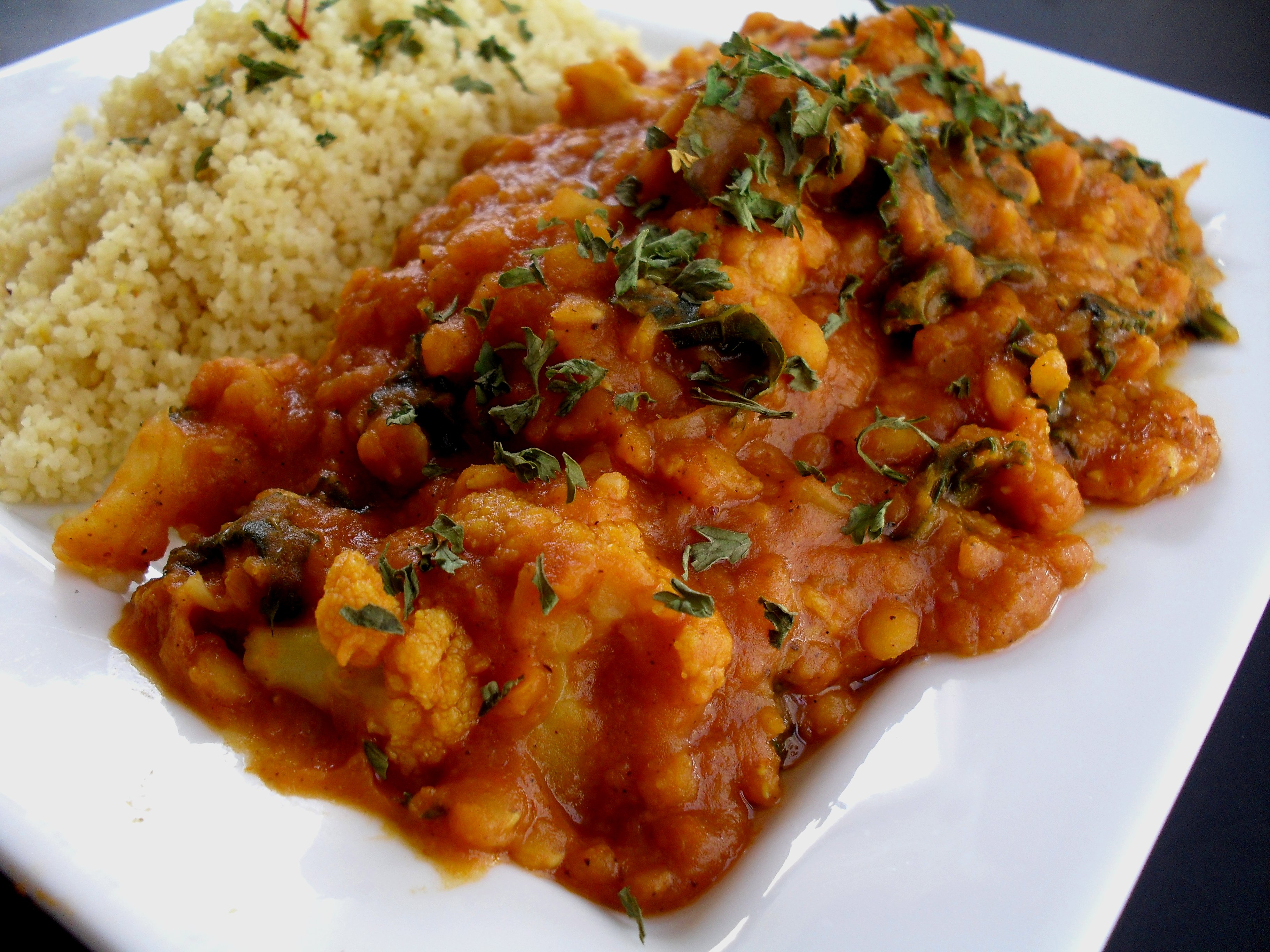
Although I still have a large backlog of recipes to post, the weather is heating up again and it looks like the casseroles, soups, and pumpkin recipes will probably have to wait until next year, so I thought I’d gush (or perhaps rhapsodize would be a more appropriate word for this blog!) about the lunch I made today instead. I’m on a mission to spring-clean my wreck of a house into sparkling submission, and I started eying the red lentils I’d purchased at a Lebanese market over a month ago while I was organizing the kitchen.
I decided I was (finally) going to make something with them, but by the time I took a break to cook, I was starving and didn’t want to bother with looking up any recipes. I needed a quick meal and I threw this one together in just over half an hour, so it would be great for a busy day. While I’m usually not a good enough cook to come up with anything edible without using a recipe, I think I knocked this one out of the park, if I do say so myself! Becoming familiar with the cuisine by cooking several Indian dishes over the last few months helped a lot.
I made a masoor dal (a thick stew made of red lentils) that is almost vegan, and could certainly be turned so by using vegetable stock in place of the water and chicken bullion. It is spicy in the full sense of the word–with plenty of Indian aromatics and and a moderate heat index, though you can certainly reduce or increase the spiciness to your tastes.
I’m usually not a fan of lentils, but I liked this more than any lentil dish I’ve made before. I’m not sure if red lentils have a better flavor (which I do suspect, because I detected none of the usual musky lentil flavor in this dish), or if the spices just overwhelmed it. The tender cauliflower pieces were a perfect accompaniment, but I don’t think the kale is absolutely necessary. I couldn’t really detect any of its flavor, and it got kind of dull & ugly during the cooking process, but I don’t think it hurts to have all that extra nutrition! Kale has powerful antioxidant properties and is considered an anti-inflammatory so if you have it on hand, throw it in! If not, don’t sweat it. The only thing I didn’t have that I really felt it needed was a little cilantro to sprinkle over the top. I had to make do with some dried parsley. Bummer!
I served mine with whole wheat couscous since I was in a hurry to eat (it only takes 5 minutes to make), but you can serve it with rice or bulgar or even pasta. Whatever floats your boat!
2 cups water
2 chicken bullion cubes
1 cup red lentils
1/2 cup chopped onion
2 cloves garlic, minced
2 (8 oz) cans tomato sauce
2 teaspoons garam masala
2 teaspoons curry powder
1 teaspoon sriracha hot chile sauce, or to taste
1/2 teaspoon cumin
1/2 head cauliflower, separated into florets
2 cups loosely packed kale
2 tablespoons extra-virgin olive oil
Fresh cilantro, for garnish
In a large 3-quart saucepan, combine water, bullion, lentils, onions, and garlic; cover and bring to a boil over high heat. Reduce heat to medium and cook for ten minutes. Stir in the tomato sauce, garam masala, curry powder, sriracha, and cumin. Add the cauliflower and kale, stir & cover. Cook for 20 more minutes, stirring often to make sure the dal isn’t sticking, or until the lentils are tender. Stir in the olive oil during the last five minutes of cooking and serve with a sprinkle of cilantro over rice or couscous.
Serves 4
Per serving: 231 calories; 8 g fat; 40 g carbohydrates; 15 g fiber; 13 g protein
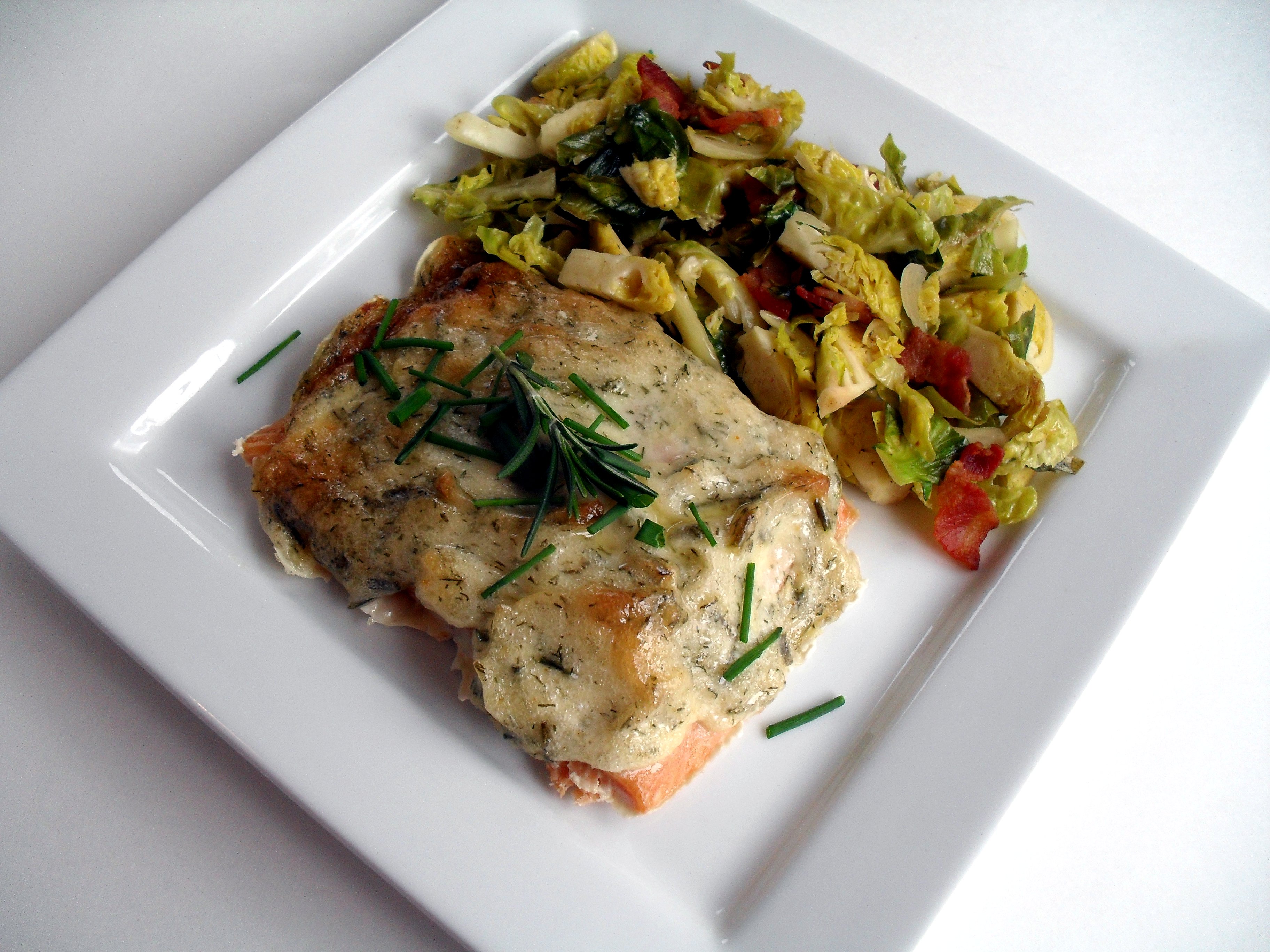
I got this idea from my friend, Rossie, who I also adapted my favorite salmon recipe from. Her favorite dinner is taking a salmon fillet, sprinkling salt and pepper (or lemon pepper) on it, slathering mayonnaise on top of that and baking until browned. I love some good salmon, so when I snagged some fresh herbs on sale, I thought of Rossie’s mayo salmon and had a little fun with it.
Dennis and I both loved it! The creamy, crusty herb-infused mayo really complimented the salmon, and was quite simple to throw together. The herbs I used went well with the fish, but I bet you could substitute any others you might have on hand. Have fun!
4 (3-4 oz) skinless salmon fillets
Salt and pepper
½ cup mayonnaise
1 tablespoon fresh rosemary, chopped
1 tablespoon fresh chives, chopped
1 teaspoon dried dill
Preheat oven to 350 and spray a baking dish with oil. Place salmon in baking dish and sprinkle with salt and pepper. Mix the mayonnaise with the herbs, the spread it over the fillets. Bake uncovered for 20-25 minutes, until the mayo gets a little brown crust.
Veronica’s note: When substituting dried herbs for fresh or vice versa, use this general rule of thumb: 1 teaspoon dried herbs = 1 tablespoon fresh.
I didn’t calculate the calories for this recipe and was wondering, as a reader, do you prefer the calorie information to be included or does it matter to you?
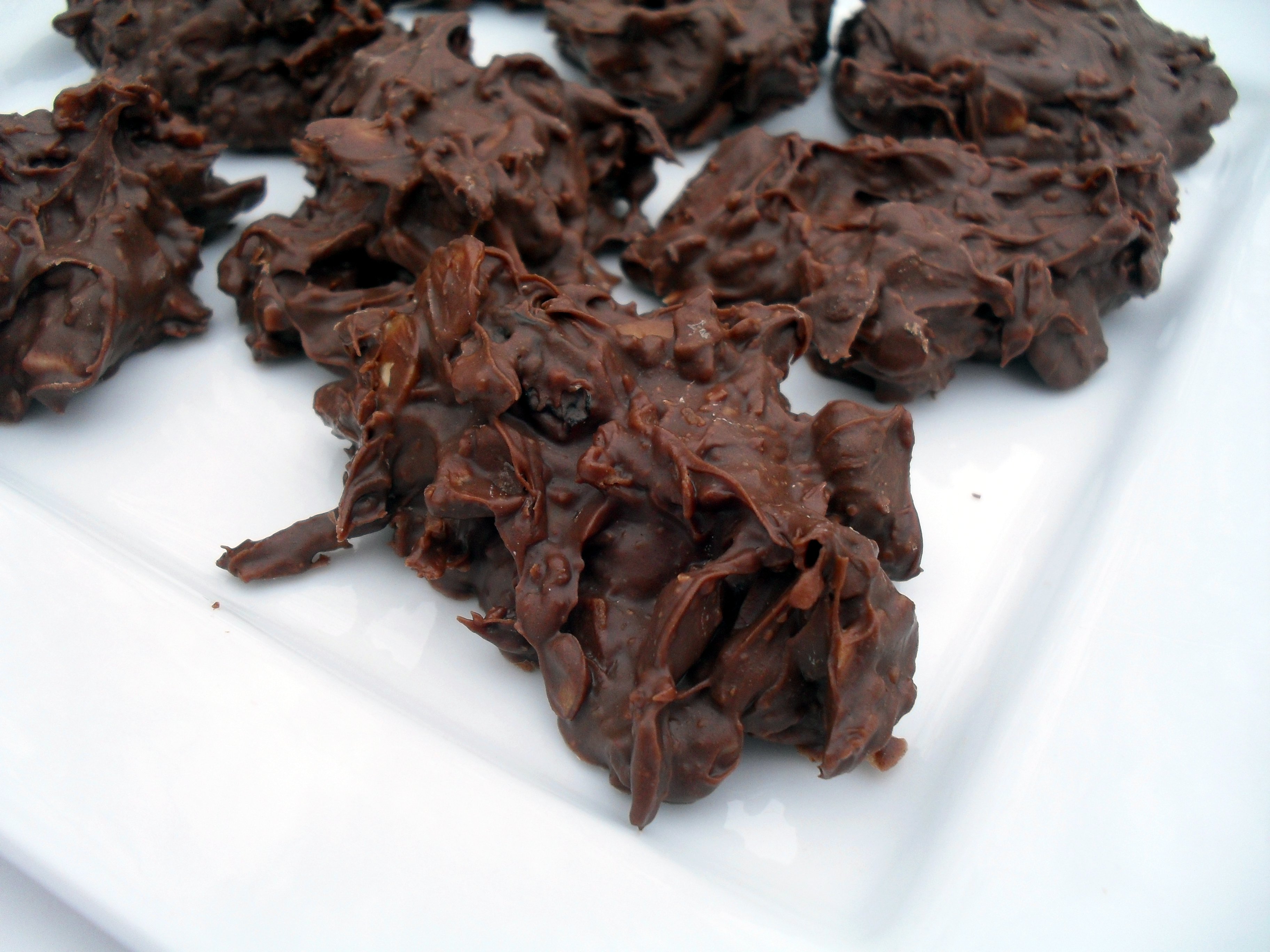
I got the above Hallmark (because I care enough to send the very best, lol!) card for my Mother-in-Law’s birthday. Most of my husband’s family lives a couple hours north of us and I usually mail some sort of edible goodies to them on their birthdays. Since I haven’t figured out how to ship a cake without destroying it, I thought this would be a great card to send to her along with some cow pies candy. Cute, if a little gross, right? :)
I’m not sure where this recipe originated but you can find it all over the web. Mine is a little different from the others, which only call for almonds and raisins with the chocolate. Because cow pies have grass in them (OK, maybe I’m getting a little too graphic here!), I like to add coconut to mimic that.
Although I went with sliced almonds this time (it was all I had on hand), my favorite way to make these is with roasted, salted peanuts, raisins, and coconut. If you like Chunky candy bars, you’ll like that version too because it is very similar in taste. (I also have an award-winning recipe for cookies that are based off the flavor profile of the Chunky Candy bar, if you’re interested in that!)
It’s best to use salted nuts to counteract the super-sweetness of the candy. If you only have unsalted, just add some salt to the mixture before stirring. Kids love these things (apparently the idea/grossness as much as the taste–KIDS!), and they would be great for Halloween…and maybe even Easter. We usually think of barn animals (OK, barn animal babies) in correlation to Easter, so I guess cow pies fits, right? Or maybe I’ve grown a little twisted over the years. I blame my husband. He is the King of Strange. I mean, remember those horrific-looking no bake cookies he made? Yeah. He totally started it.
1 (12 oz) bag milk chocolate chips
1 tablespoon vegetable shortening
2/3 cup roughly chopped salted nuts*
1/2 cup packed raisins
1/3 cup packed shredded coconut
*Add 1/4 teaspoon salt to the recipe if not using salted nuts.
Gently melt chocolate and shortening together in double boiler or in microwave, stirring frequently until smooth. Stir in remaining ingredients. Drop spoonfuls onto a wax paper lined baking sheet and let sit until firm, about an hour.
Veronica’s Note: If you want to add more mix-ins, decrease the amounts of the other mix-ins accordingly (for instance, decrease nuts to ½ cup and raisins to ⅓ cup in order to add an additional ⅓ cup mix-ins). Ideas for mix-ins: toffee bits, crushed pretzels, bacon bits, crumbled potato chips, additional types of nuts or dried fruits.
Makes 24 candies. Per serving: 121 calories; 7.6 g fat; 12.7 g carb; 1.1 g fiber; 2.2 g protein
Growing up, I always made goulash with an Italian flare because I did not understand what goulash was supposed to be. (Obviously I was a self-taught cook–Mom and I did not get along well together in the kitchen so I did things my way!) I equated pasta and tomatoes with Italian, so I added in Italian spices and used spaghetti sauce to coat the noodles. I have finally come to understand that goulash has Hungarian roots and although my latest concoction is more how most Americans make it, I can’t claim that it has any resemblance to the original dish it was named for. All I can say is that it’s fast, it’s delicious, and satisfying!
1 cup whole wheat elbow macaroni
1 1/2 lbs 97% lean ground beef
1 onion, chopped
1 green pepper, chopped
2 (14.5 oz) cans stewed tomatoes
1 (8 oz) can tomato sauce
1 (6 oz) can tomato paste
1 teaspoon paprika (Hungarian if you have it!)
1 teaspoon garlic powder
fresh cracked pepper
Boil macaroni until al dente. Meanwhile, cook hamburger along with onion and green pepper in skillet over medium-high heat until cooked through; drain. Add in remaining ingredients, stirring until the tomato paste is dissolved, and stir in macaroni. Serve hot.
Makes 8 servings: 271 cal; 6.8 g fat; 32.3 carb; 5 g fiber; 23.8 g protein
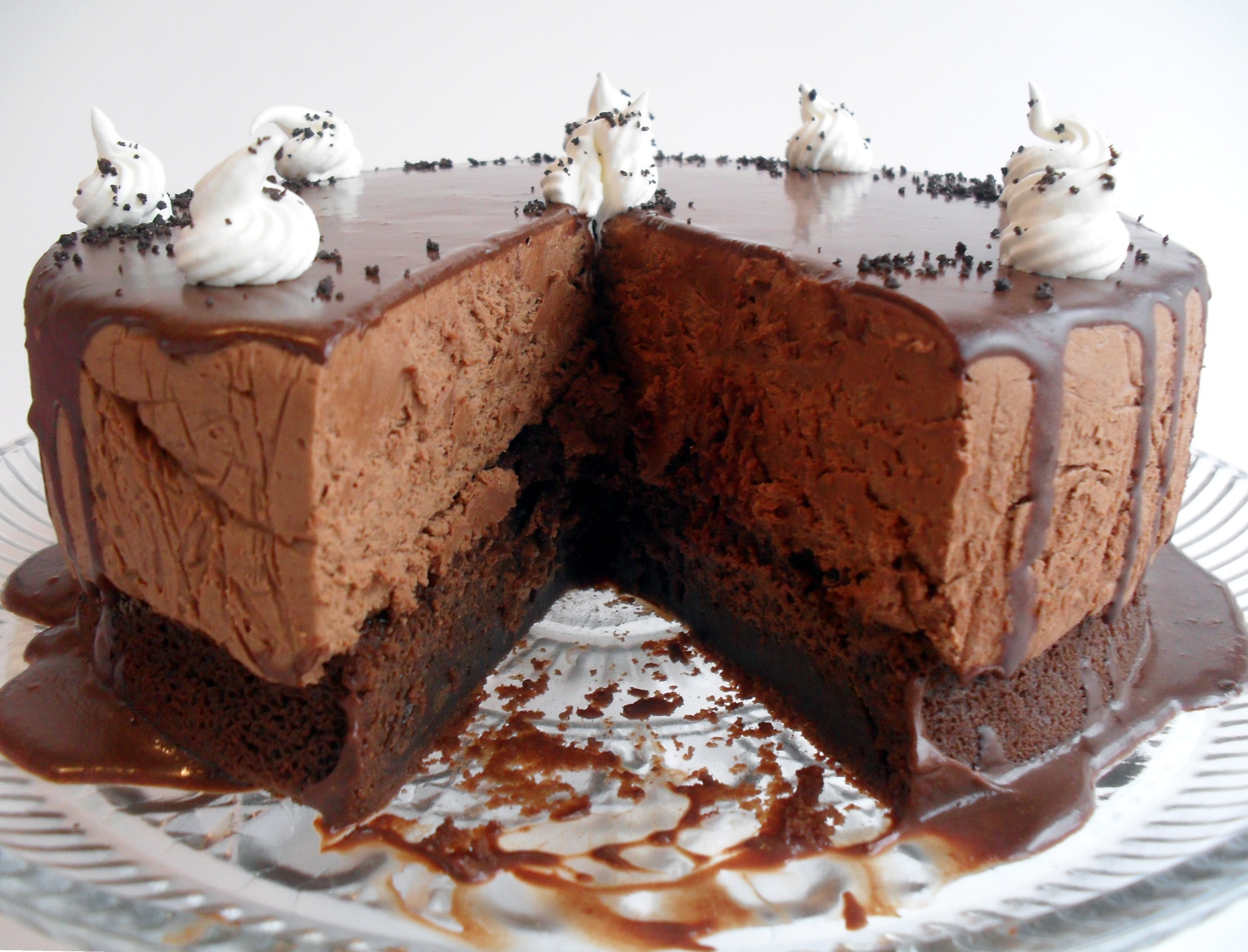
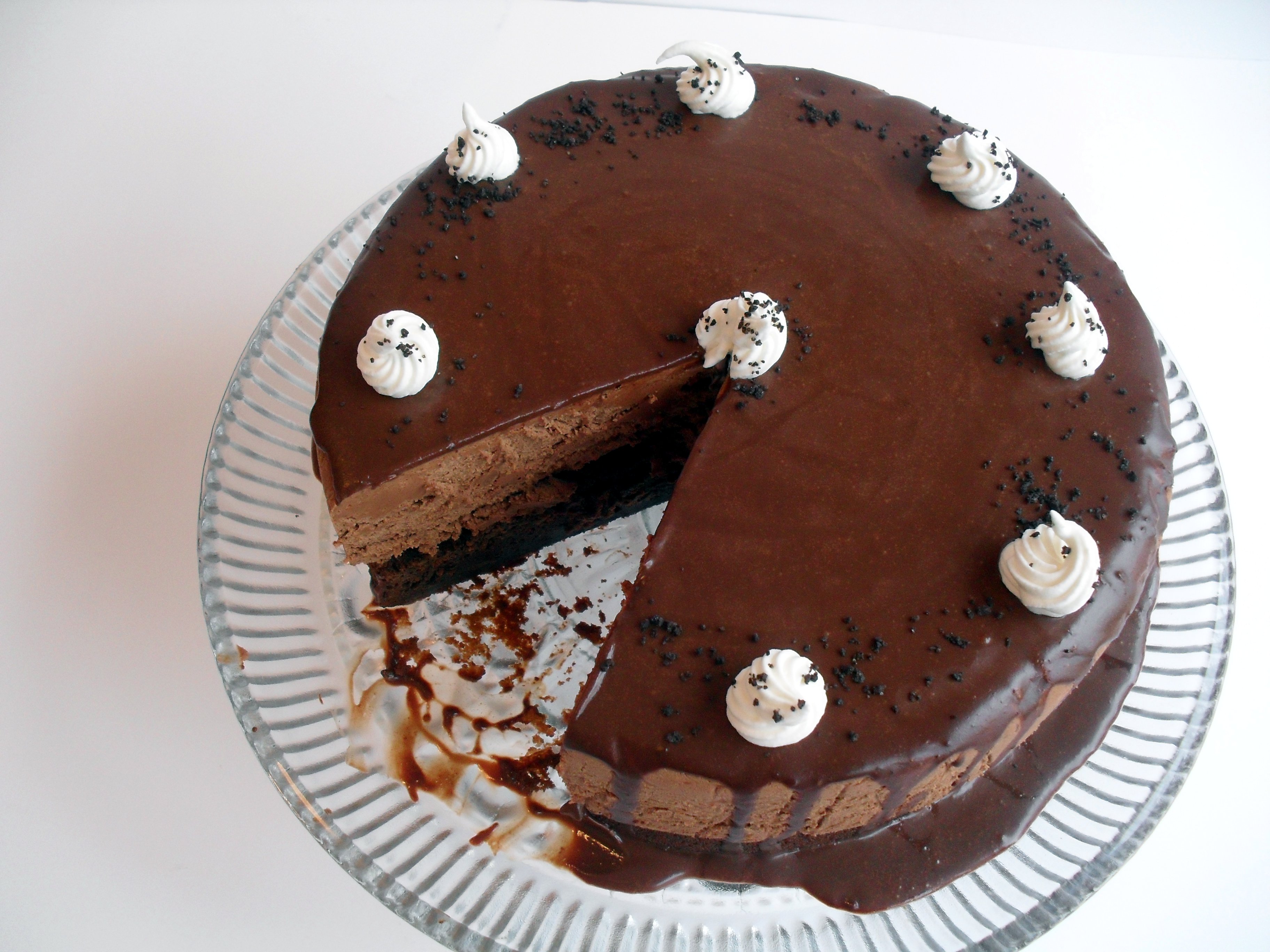
This is a dessert served on the Carnival Cruise ships (or at least it used to be in the late 90s), which I have made several times for my Mother as her birthday cake. It is one of her favorite cakes, right up there with THE Mocha Crunch Cake, and just as rich…and decadent. They aren’t kidding when they named this dessert, it really is chocolate decadence. No better way to describe it.
I originally made this according to their recipe, which is actually broken up into parts, referring to basic recipes in the “Chef’s Notes” in the back of the Carnival Creations cookbook for everything but the mousse layer. The cake consists of four recipes all combined to make one dessert: the cake layer, the mousse layer, the thin ganache layer, and the strawberry sauce. I felt that the chocolate sponge cake they used was much too dry for the dessert, and lacked in chocolate flavor since it contained only a few tablespoons of the good stuff. So I replaced it with my own simple one-bowl deep chocolate cake layer and was pleased with the result. It’s my first attempt at my own cake recipe and while it’s probably not perfect, it was perfect for this dessert. Moist, rich and fudgy, nicely complementing the rich rum-infused chocolate mousse.
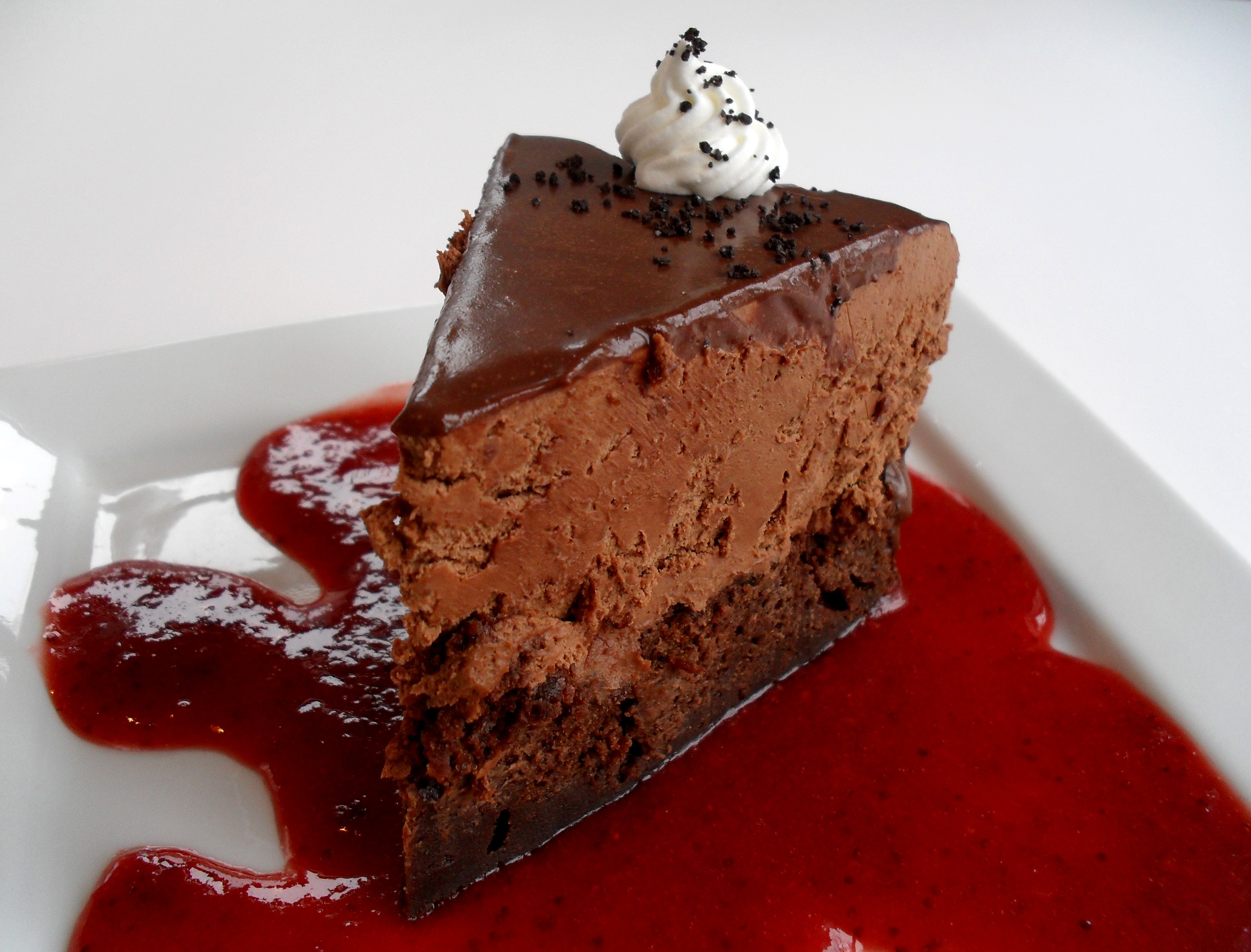
I stuck with the recipe for the mousse, as that was always lovely and really is the star of the dessert. It firms up in the fridge and when you take a bite, it’s akin to eating a lightly textured truffle with cake underneath. Superb. My middle sister says it almost seems like you’re eating candy rather than cake but I say…it’s the best of both worlds!
When it came to the ganache layer, I considered making a real ganache, using heavy cream, but realized that since this dessert is served from the refrigerator and real ganache gets rock hard when chilled, it would be prudent to stick with this thinner ganache (or what I’ll now call a chocolate sauce) which thickens a little in the fridge but it still nice and soft when you cut into it.
As for the strawberry sauce, their recipe doesn’t make nearly enough (individual tastes may vary, but my family enjoyed having a large puddle of sauce on their plate beneath the small slices I served. Although the cake is wonderful alone, every bite seems improved when accompanied by a good dose of strawberry sauce!) and I wanted to use a bag of frozen strawberries I had in the freezer rather than buy fresh out of season, so I made my own recipe. You can use any recipe you like for the sauce, but if you want to use mine, you can click the link to it below.
This cake went over very well with my family. Although my Mom has always liked it, even in the days when I made it with the dry sponge cake underneath, the rest of my family never got very excited about it until I replaced the cake this time. Apparently that was the only change it needed, besides the increased amount of sauce. My little sister usually prefers citrus cakes (preferably unfrosted), but she proclaimed this “the best chocolate cake I’ve ever had.” I have to admit, I felt a little piqued at this since her devotion previously belonged to my beloved Mocha Crunch Cake, the cake I prize most…but I got over it because ultimately she still giving high praise to something I created. I’ll take it. :)
The recipe is a bit time-consuming since there are so many parts, but you can pace yourself and make the sauce several days in advance, the cake the day before (wrapping it in plastic wrap and refrigerating in the mean time), and since the cake needs to sit in the fridge overnight after you make the mousse and place the cake on top (which will later be flipped over), you can wait until the next day to make the ganache if you want. Take it little by little and it won’t seem so overwhelming.
I hope you give this one a try for a special occasion–it is worth the effort and sure to impress!
Cake
1 cup all-purpose flour
1 cup sugar
½ cup cocoa powder
1 teaspoon baking powder
½ teaspoon salt
1 cup milk (I used coconut milk beverage)
¼ cup vegetable or canola oil
¼ cup warm water
1 egg
1 teaspoon vanilla
Mousse
1 lb. semisweet chocolate, chopped
2 tablespoons heavy whipping cream
6 tablespoons unsalted butter, softened
¼ cup Myers rum
6 egg yolks
½ cup granulated sugar
1 ½ cups heavy whipping cream
Chocolate Sauce
1/3 cup whole milk
3 ounces semisweet chocolate, chopped (about 1/2 cup chips)
1 teaspoon butter, softened
Make the cake: Sift dry ingredients into a bowl, stir, and then add the remaining ingredients. Beat with a whisk until smooth, scraping down bowl. Pour into a greased and floured round 8” pan. Bake at 350 for 40 minutes or until tester inserted in center comes out clean or with a few moist crumbs. Cool five minutes on rack in pan, then remove from pan to cool completely, about 1-2 hours.
Make the mousse*: gently melt semisweet chocolate in a double boiler or microwave; stir in whipping cream. Cool. When cool enough that butter will not melt, beat in butter. Stir in rum. In large bowl beat egg yolks and sugar on high speed for 5 minutes or until very light; fold into chocolate mixture. In large bowl beat whipping cream until soft peaks form; fold into chocolate mixture. Line an 8” round baking pan with enough plastic wrap that it comes over the sides; spread mousse into pan. Place cake top side down on top of the mousse and press down to make sure that every part of the cake is in contact with the mousse and that the top is flat. Cover with plastic wrap and refrigerate overnight.
Make the chocolate sauce: Place the chocolate in a food processor or blender. Heat the milk until steaming hot, then turn on the food processor and, while running, pour the hot milk through the feed tube. Blend until smooth and allow to cool.
To serve: Place cake plate upside down on top of the cake, then flip over. Lift the cake pan off the cake (you may have to wiggle it or have someone hold down on the plastic wrap “handles” while you lift the pan). Remove plastic wrap; spread chocolate sauce over the top and refrigerate for at least ten minutes. Cut into 16 slices; serve with a dollop of whipped cream and strawberry sauce.
*Veronica’s note: I only make this cake once every three or so years, so I can’t recall my previous experiences with the mousse very well, but this time I had problems with the mixture wanting to get too thick every time I let it sit so I could beat eggs or beat whipped cream. To soften it back up before adding those elements, I just rebeat it with the same hand-held mixer I had just used on the eggs or whipped cream, then folded them in. I’m not sure if this is usual or if I overheated my chocolate (which can make chocolate thicker if it doesn’t altogether seize up) so I wanted to mention it just in case others had this difficulty. It is surmountable so do not despair! :)
Per serving (without sauce or whipped cream): 473 calories; 30.5 g fat; 50.5 g carb; 3.2 g fiber; 5 g protein
2 tablespoons strawberry sauce: 42 calories; 0 g fat; 11 g carb; .6 g fiber; .1 g protein
Recipe source: cake and strawberry sauce recipes by Veronica Miller; mousse recipe, dessert concept, and chocolate sauce adapted from Carnival Creations.
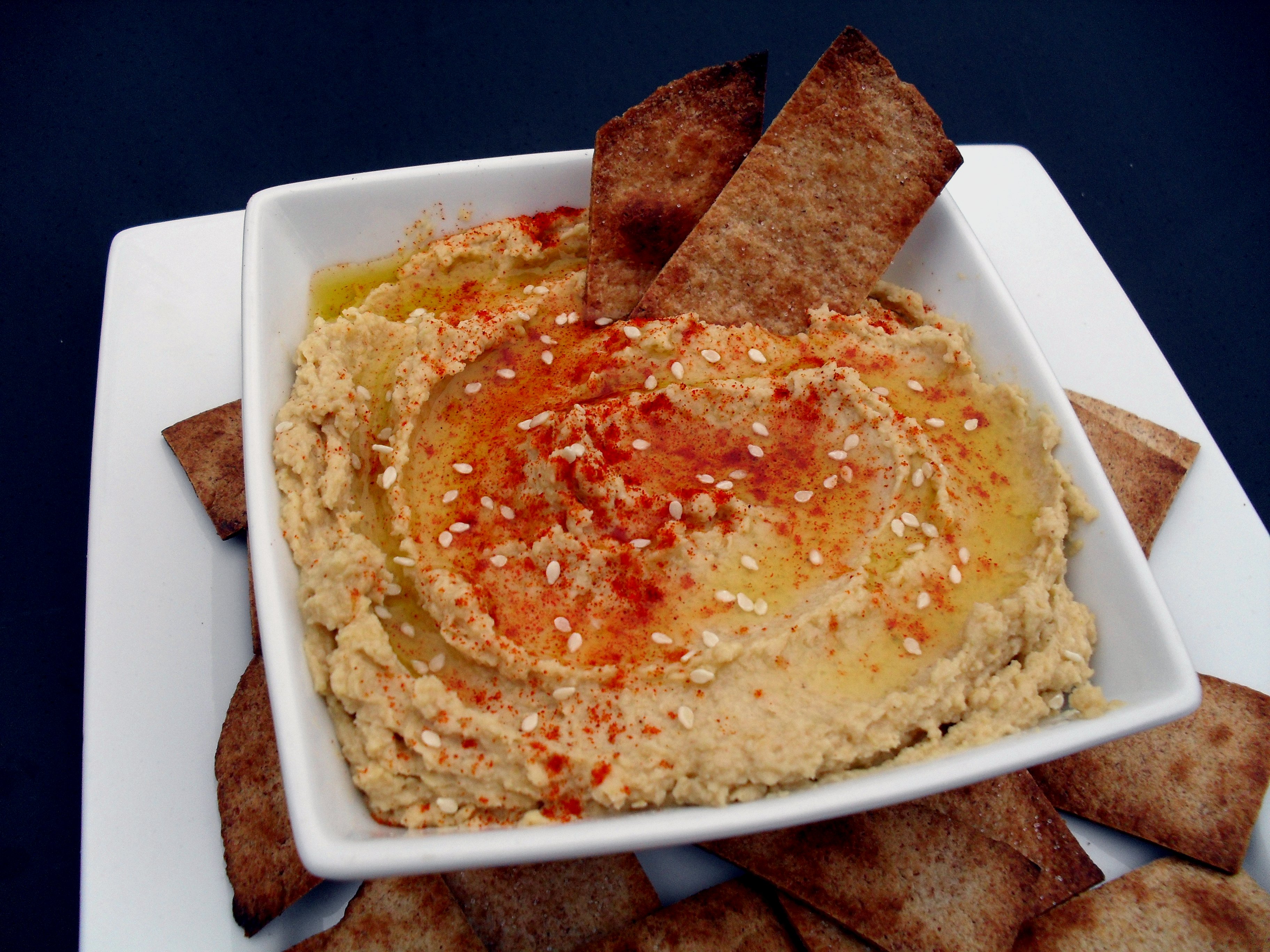
Somehow, over time, hummus has become my favorite food. The food I think I could live on if I had to choose just one. I eat it almost every day, sometimes with pita chips, sometimes with baby carrots, and sometimes with homemade whole wheat tortilla chips. I often replace whole meals with it!
Hummus is essentially a white bean dip that originates in the Middle East and usually contains chick peas (garbanzo beans), tahini (sesame seed paste), lemon juice, olive oil, garlic, salt, and cumin. Most basic recipes contain all these and the only difference seems to be the amount used and the preparation methods.
I’m going to share my own recipe for hummus with you, one that is not only approved by me (a lover of all hummus), but by my husband, who used to detest hummus. I tried countless times to get him to like it, making him sample it every time I ordered it at a restaurant or bought some from the store, but he never enjoyed it until I started making it at home. I had almost given up hope and it does me good to have converted him, because now that we’re both eating it, it doesn’t hang around as long, tempting me to eat it all in one sitting.
You can always add less or more of any of the ingredients to make it to your own tastes, and there’s no reason you can’t have some fun and make variations on this basic recipe. I’ve made it into a sauce by adding yogurt, and I’ve also added pesto for a sandwich spread, inspired by Debbi’s recipe. My foodie twin, Melissa (so called because we have often cooked up the same thing in our kitchens over a thousand miles apart without realizing what the other is up to), likes to mix balsamic vinaigrette with hummus for a salad dressing and I can’t wait to try it that way. My blogger buddy, Biz, has made a beautiful beet hummus, and of course there’s always classic variations like roasted garlic & red pepper. Let your imagination run wild!
2 (15.5 oz) cans chickpeas, drained and water reserved
1/4 cup extra virgin olive oil
1/4 cup tahini
1/4 cup lemon juice
3 cloves garlic, minced
1 tablespoon ground cumin
salt to taste
Toast the cumin by placing it in a microwave-safe dish and microwave for one minute or until fragrant. Combine all ingredients in food processor with 1/2 cup of the reserved water and turn on. While it is running, slowly add more reserved water (I use another 1/2 cup or more) through the feeding tube, stopping to scrape down the sides, until the hummus is your desired consistency. Continue processing until smooth. Taste and add salt if desired. I like to sprinkle mine with paprika and drizzle with olive oil for a pretty presentation, and you can also use sesame seeds and additional garbanzo beans on top. Serve with pita chips, baked flour tortilla chips (recipe follows), or baby carrots. Refrigerate leftovers in a covered container.
To make your own baked tortilla chips, cut wheat tortillas (I like whole wheat, or use corn if you’re making them for another dip, like salsa) into desired shapes and put in an even layer on a baking sheet lined with foil and sprayed with cooking oil. Spray the tortillas with oil and sprinkle on some salt. Bake at 350 until edges are starting to brown, about 5 minutes depending on size of chips, turn them and bake for a few more minutes until browned. Chips will crisp upon cooling. Store leftovers in a Ziploc bag or airtight container.
Per serving (based on 16 servings and calculated without chips or carrots): 115 calories; 6.5 g fat; 11.5 g carb; 3.8 g protein
After posting the recipe for a lighter Northern cornbread, I got some feedback I wasn’t expecting. Namely, from readers informing me that cornbread wasn’t made with flour, only cornmeal.
What?
I mean. WHAT?!
How could this possibly be? Mom made her cornbread with whole wheat flour. Every cornbread recipe I’ve ever seen includes flour. Why have I never heard of cornmeal-only cornbread?!
I scoured the internet for a cornmeal-only recipe, and came up empty. I consulted a friend in Kentucky who told me that cornmeal-only cornbread is a Southern thing (and she also told me I had to use buttermilk) so I searched for “Southern cornbread.” Every recipe had flour. So I searched for “buttermilk Southern cornbread.” All had flour. Desperate, I just did a generic “cornbread” search and yielded the same results. The only difference in the vast amount of recipes was the amount of cornmeal and flour, the type of milk used, and whether or not there was sugar added.
I remembered that my cornmeal sack had a cornbread recipe on the back so I consulted that. Score! It was called “Homestead Cornbread” and only called for cornmeal, but it called for regular milk and Carla had specifically told me I had to use buttermilk. She also insisted I top it with real butter. Carla is from the South and she knows what she’s talkin’ ’bout so I decided I’d better come up with my own recipe (and top it with real butter) to make her happy.
You know southern women. They’re all charming and “bless your heart!”…until you try to serve them sweet cornbread with whipped honey butter and then the fangs come out! Or so I imagine, based upon how heated the North & South cornbread debate can get. ;)
*Disclaimer: I apologize to any Southern women reading this. I was totally only saying that to amuse the Northerners. Please don’t bite me!
So I got to work and made us a big ‘ol mess of beans (I’m trying to talk like Paula Deen since I’m doing the whole Southern cornbread thang here), because that’s just what you eat with cornbread (or am I wrong about this too?), and baked up my version of REAL southern cornbread.
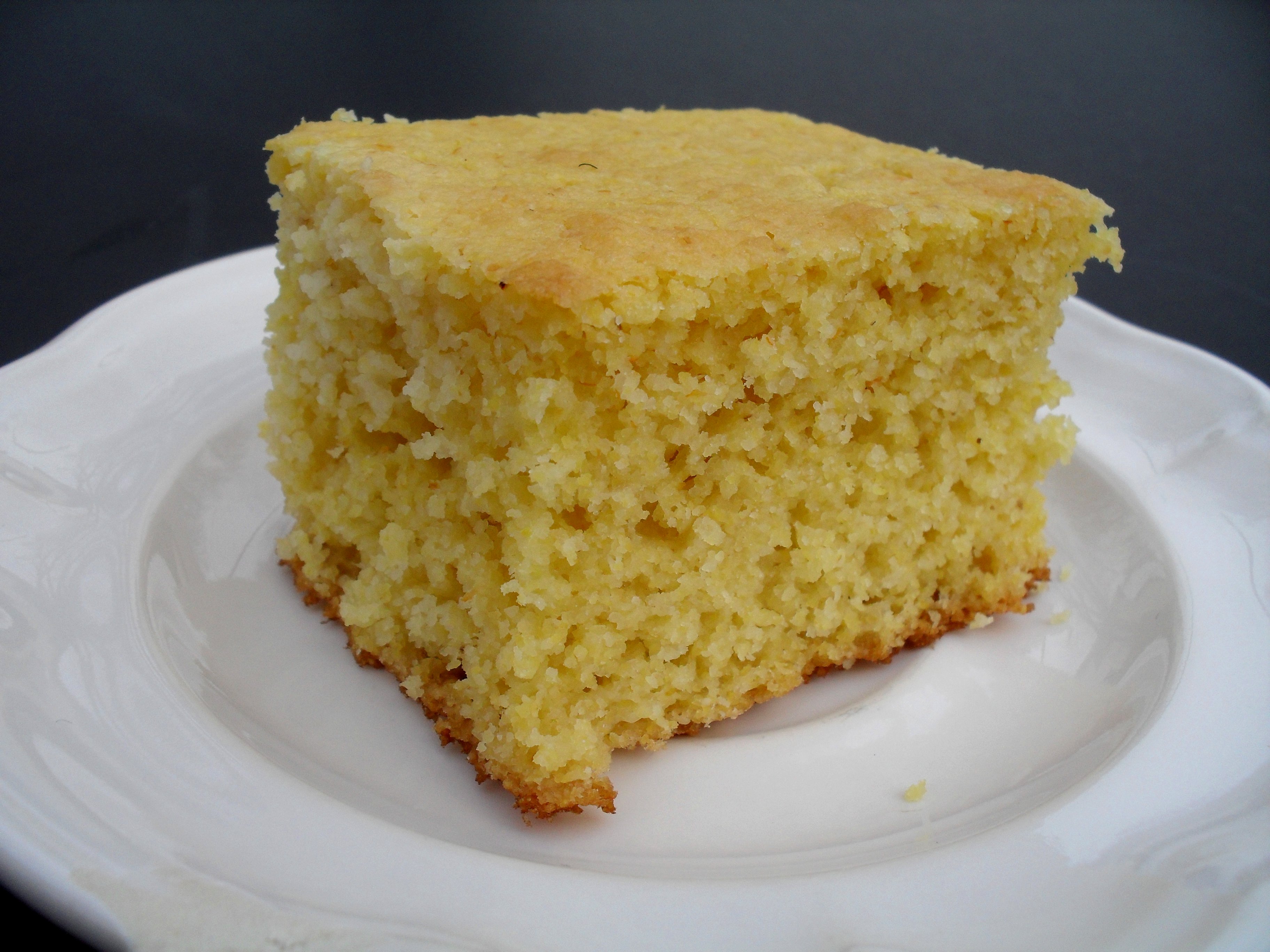
Until I made this, I was convinced that the sweetened, moist stuff I’d been making lately was an abomination and I should be ashamed of myself for stooping so low as to make something that you didn’t have to drown in butter to keep from choking down. That’s just how cornbread was supposed to be. Dry and unsweet. But now I can officially say (my apologies to the Southern folks) that I’m a true Northern cornbread convert.
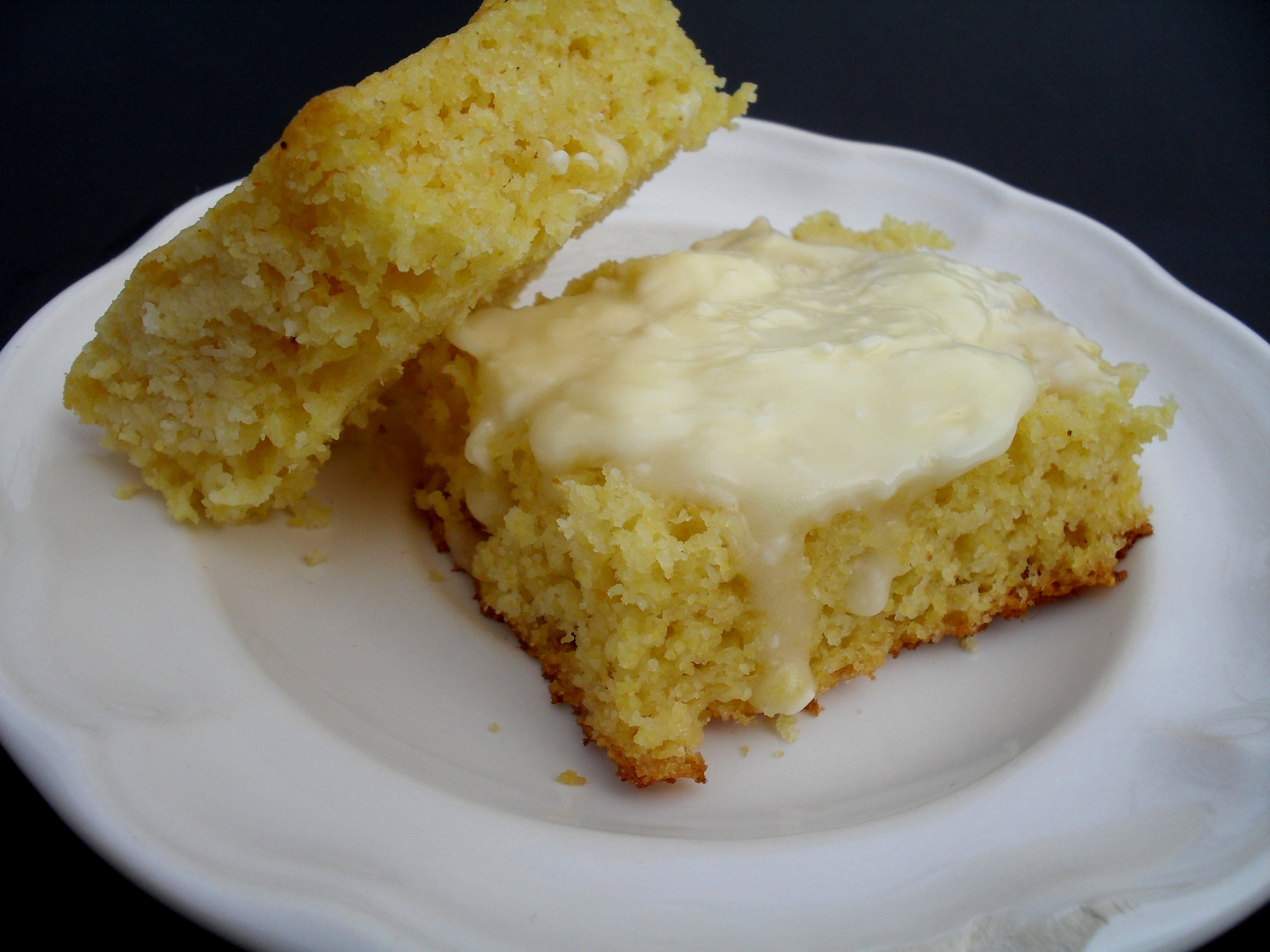
Now, this stuff is wonderful if you do indeed slather it with a generous amount of (real) butter, and even better with some honey (I guess I missed the sweetness), but without them it is a little dry and crumbly. What do you expect? There’s no flour in it! But if you were raised on this kind of cornbread, and are looking for a recipe and discovered them hard to find, I’m going to include it here for you because I realize that folks are loyal (except in my case, apparently) to the foods they were raised on. And this one is especially good for crumbling over your beans, which means you can get your cornbread and beans in every bite! I love that. Oh, oh, oh! This one would also be superb for making cornbread stuffing. Mmmm….is it too early to start planning Thanksgiving dinner?
Preheat oven to 425 degrees. Combine dry ingredients. Add milk, egg, and oil and mix well. Pour into well-greased 8-inch square pan (the batter will come up high but don’t worry, it doesn’t rise much) and bake for 25-30 minutes. Cut into rows of 4×3 to make 12 squares.
Per serving: 120 calories; 4.2 g fat; 17.4 g carb; 1.5 g fiber; 3.7 g protein
*Veronica’s notes: it’s important to use aluminum-free baking powder in recipes calling for more than a teaspoon, otherwise you will get an unpleasant metallic aftertaste. If I were to make this again, I’d bump up the oil to 1/4 cup to make it a little more moist. To make this with regular milk, use 5 teaspoons of baking powder and omit the baking soda.
Recipe source: adapted from the back of a Shawnee Best yellow cornmeal sack.






















 Veronica's Cornucopia