RSS Feed

Category Archives: Sweets

Brown Butter Chocolate Chip Cookies

Posted on

Update: I won a blue ribbon for these cookies at the 2011 Kansas State Fair!

Cookies are my favorite food group and I’ve never met a cookie I didn’t like, but never had a favorite until fairly recently.

And the winner is… [drumroll]

chocolate chip cookies {insert sheepish grin here}

But these aren’t just any chocolate chip cookies, people.  These are chocolate chip cookies made with brown butter, toasted & ground-up oatmeal, toasted nuts and just enough vinegar to make an extremely tender cookie without adding any flavor.

I suppose I always knew that chocolate chip cookies would eventually beat out all the rest for me, because I have made countless batches of them in an effort to find the perfect recipe.  I’ve never done this with anything else. All were good, but none left me with the feeling that I’d found the best.  Until I found this one.

Allow me to introduce you to the creator of this recipe, Laura Flowers: culinary genius and food blogger extraordinaire.  (If you use that to title your autobiography, Laura, I want 10% of your profits!)  Every week she posts new recipes–most of them her own–for everything from cookies to pizza (those are my favorite) to salads & pasta dishes.  I have tried several and have yet to be disappointed.  And I’m eternally grateful to her for bringing the torture of my endless search for the perfect chocolate chip cookie to an end!

Today I made them for Laura’s “Project Cookie” and mailed them to her friend Ted & his platoon in Iraq.  Well, I mailed most of them (minus the usual dozen I can’t keep from eating every time I make them!)

Brown Butter Chocolate Chip Cookies

Printable recipe
Printable recipe with picture

1/2 cup old-fashioned oatmeal
1 cup (2 sticks) softened butter
3/4 cup packed light brown sugar
3/4 cup granulated sugar
1 teaspoon salt
1 Tablespoon real vanilla extract
1/2 teaspoon white vinegar (You won’t taste it, I promise.)
2 large eggs
1 1/2 teaspoons baking soda
2 cups all-purpose flour
1 cup chopped walnuts or pecans (optional, but add 1/4 cup more flour if omitting)
1 (12-oz) bag semi-sweet chocolate chips

1. Preheat oven to 350 degrees. Line baking sheets with parchment paper.

2. In a nonstick skillet, melt 1 stick of the butter over medium heat until foamy and golden brown. You’ll know it’s ready when the solids have separated and the bottom has lots of brown specks and it starts to smell so wonderful that you get light-headed when you catch a whiff. Pour into a bowl to cool and wipe out the skillet.

3. In the skillet over medium heat, toast the oatmeal, stirring often, until fragrant and some of the oatmeal is light golden in color. About 3 minutes. Transfer the oatmeal to a food processer and grind until fine and powdery. I usually just turn it on and leave it alone for a full minute. Set aside.

4. If using, spread the nuts onto a plate and microwave in 30 second increments 2 or 3 times until toasted, stirring in-between. Set aside to cool.

5. In a stand mixer, beat the softened butter, browned butter, brown sugar, granulated sugar, salt, vanilla extract, and vinegar low to combine, and then on high speed until fluffy and lighter in color. I beat mine about five minutes so that there’s plenty of time for all those sugar crystals to force air into the butter. (Alton Brown has convinced me this is crucial to making good cookies and since I do this and my cookies are always good, you should believe us both.)

6. Add the eggs and mix until combined. Add the oatmeal and baking soda and beat for another minute. Next, add the flour half at a time and mix on low speed just until incorporated.

7. Add the chocolate chips and toasted nuts. Mix on low until incorporated.

8. With a size 50 cookie scoop or a generous tablespoon, drop the dough onto parchment paper 3 inches apart.

9. Bake for 11 minutes or until golden around the edges. I use an airbake pan and usually bake mine about 10 minutes, but oven temps vary so just keep an eye on the first pan to judge the time yours needs. Remove from oven and let set on the cookie sheet for 3 minutes before moving to a cooling rack. *I prefer to take my cookies out of the oven when they are puffy & still a little raw looking because the residual heat from the pan continues to bake them and this yields a cookie that is slightly crisp on the outside and very soft & chewy on the inside.

Makes about 45 cookies.

Note:   These cookies are best baked shortly after mixing the batter together. There is no need to refrigerate the dough.

Recipe source: The Cooking Photographer, with some slight modifications by me

Now it’s time for some fun! If your favorite cookie isn’t listed below, feel free to leave it in a comment.  You can also leave links–I can never have enough cookie recipes.  Like I said, cookies are my favorite food group. :)

Secret Recipe Club

Nutty Toffee Popcorn

Posted on

Although I have an overabundance of saved recipes that I have yet to try, I still couldn’t resist purchasing Taste of Home’s “Bake Sale 2009” magazine when I spotted it on the shelf at the grocery store.  I want to make everything in the book (it doesn’t hurt that pictures accompany each recipe!), but this is the first thing I’ve tried.

It is really hard for me to stick to a recipe exactly, and this one is no exception.  Come on, a recipe with toffee in the title and none in the recipe?  That had to be fixed!  So here’s my version.

Nutty Toffee Popcorn

Adapted from Glenna Hale’s recipe in Taste of Home’s Bake Sale 2009

½ cup popcorn kernels
1 cup pecan halves
1 cup whole almonds (I used roasted & salted)
1 c butter
2 c packed brown sugar
½ c light corn syrup
½ t cream of tartar
½ t baking soda
½ t rum extract
½  cup toffee bits (like Heath baking bits)

Preheat oven to 200 degrees. Pop kernels (I use an air popper) and place in a large bowl.  Sprinkle the nuts over the top of the popped popcorn and set aside.

Melt butter in a heavy-duty saucepan over medium heat, then stir in the brown sugar, corn syrup and cream of tartar.  Bring to a boil over medium heat and boil, without stirring, for five minutes (if you have a candy thermometer, you can clamp it to the side of the and wait until the mixture reaches 300 degrees F).  Remove from heat and stir in baking soda & rum extract until mixture is light and foamy.  Immediately pour over the popcorn mixture & stir to coat well.  Bake in a large roaster pan or two jelly roll pans for 1 hour, stirring every 15 minutes.  The last time you stir, when only 15 minutes remain, sprinkle the toffee over the top, stir and return to the oven. When it has baked an hour, lay sheets of waxed paper on the counter and spread the popcorn over it to dry, breaking up the pieces with a spoon as you spread it out. Once it has cooled, store in an airtight container.  I usually just put mine into gallon-sized Ziploc bags.  In this case, I only needed one b/c only half the popcorn survived to the packaging step!

Black Rice Pudding

Posted on

This stuff is just amazing.  I adore it!  The coconut milk and sugar makes it a little heavy on the calories, but I justify the splurge by reminding myself that the black rice is chock full of antioxidants, even more than blueberries!

Commonly served for breakfast in parts of Southeast Asia, this dish also makes a great dessert. Chinese black rice, sometimes called forbidden rice, works well, but if you live near a Southeast Asian market you can use this same method with the more traditional Thai black sticky rice.

If you can’t find any kind of black rice, substitute brown rice (not quick-cooking) — it will result in a thicker, light-colored pudding but will still be delicious.

Black Rice Pudding

Printable recipe

1 cup black rice
1/2 teaspoon salt, divided
1/2 cup sugar
1 (13 1/2- to 15-oz) can unsweetened coconut milk, stirred well

Bring rice, 3 cups water, and 1/4 teaspoon salt to a boil in a 3 to 4-quart heavy saucepan, then reduce heat to low and simmer, covered with a tight-fitting lid, 45 minutes (rice will be cooked but still wet). Stir in sugar, a scant 1/4 teaspoon salt, and 1 1/2 cups coconut milk and bring to a boil over high heat, then reduce heat to low and simmer, uncovered, stirring occasionally, until mixture is thick and rice is tender but still slightly chewy, about 30 minutes.

Remove from heat and cool to warm or room temperature, stirring occasionally, at least 30 minutes. Just before serving, stir pudding and divide among 8 bowls. Stir remaining coconut milk and drizzle over pudding.

Recipe source: Gourmet, December 2005

Chocolate Eclair Squares

Posted on

I. LOVE. CHOCOLATE. ECLAIRS.

 
Which is one reason why it took me so long to try this recipe.  French vanilla pudding and graham crackers?  There’s no way that combination could yield anything that even remotely resembled my beloved eclairs (or so I thought).
 
Thankfully I got over myself and made the recipe because it really is almost exactly like a chocolate eclair–so similar I was truly amazed. I don’t know how it’s possible, but I’m too busy eating them to try and figure it out.  Even my husband, who didn’t think he liked eclairs, ate two helpings of this desserts, so either it’s different enough that anyone can enjoy it or he was just delusional…which is more likely to be true.  I mean, is it even possible to not like eclairs?  I think not. 
 
Without further ado, I present to you the recipe that’s been floating around so long who knows where it originally came from.  My source is the great baking legend herself, Marina Castle (aka Food Editor).
Chocolate Eclair Squares
Splendour In My Kitchen by Marina Castle
Serves 12
 
Filling
1 (14.4 oz) box honey graham crackers
2 (4 oz) boxes French vanilla instant pudding mix
2 3/4 c whole milk
1 (8 oz) container Cool Whip
 
Topping
6 T cocoa powder
2 T vegetable oil
2 T light corn syrup
2 t vanilla extract
3 T butter, softened
1 1/2 c powdered sugar
3 T whole milk
 
Blend pudding mixes with milk until thickened, then beat in Cool Whip.  Butter a 9×13 inch pan.  Arrange crackers in a single layer on the bottom.  Pour half the pudding mixture over the top and cover with another layer of graham crackers.  Cover them with the other half of the pudding mixture and finish with a final layer of graham crackers.  Refrigerate for 2 hours.
 
Blend all topping ingredients well, then spread over the top of the dessert.  Refrigerate overnight and cut into 12 squares to serve.


Tunnel of Fudge Cake

Posted on

This is an old recipe–a Pillsbury Bake-Off winner from 1966!  As the cake bakes, it mysteriously develops a “tunnel of fudge” filling.  This is the first time Dennis & I have tried it and we both agree with the 1966 Bake-Off judges–it’s a winner!

Originally a Pillsbury fudge frosting mix was stirred into the batter but when that product was discontinued, Pillsbury updated the recipe (with powdered sugar & cocoa to replace the mix) so that we could continue to enjoy this timeless classic.


Tunnel of Fudge Cake
Don’t scrimp on the nuts or it won’t work!

Cake
1 3/4 cups sugar
1 3/4 cups butter, room temperature
6 eggs
2 cups powdered sugar
2 1/4 cups all-purpose flour
3/4 cup unsweetened cocoa
2 cups chopped walnuts

Glaze
3/4 cup powdered sugar
1/4 cup unsweetened cocoa
4-6 teaspoons milk

Heat oven to 350°F. Grease and flour 12-cup fluted tube cake pan or 10-inch tube pan. In large bowl, combine sugar and butter; beat until light and fluffy–about five minutes. Add eggs 1 at a time, beating well after each addition. Gradually add 2 cups powdered sugar; blend well. By hand, stir in flour and remaining cake ingredients until well blended. Spoon batter into greased and floured pan; spread evenly.

Bake at 350°F. for 45 to 50 minutes or until top is set and edges are beginning to pull away from sides of pan (don’t bother testing for doneness as the fudgy tunnel will leave a wet toothpick even when the cake is done).  Cool upright in pan on wire rack 1 1/2 hours. Invert onto serving plate; cool at least 2 hours.

In small bowl, combine all glaze ingredients, adding enough milk for desired drizzling consistency. Spoon over top of cake, allowing some to run down sides. Store tightly covered.

*Veronica’s notes: I only baked mine for 40 minutes, but you can see that it had quite a large “tunnel” so I recommend baking for the full 45 minutes, even if using a dark pan and/or the top looks set any earlier.  Also, after inverting the cake onto the cake plate, I just left the bundt pan on top to keep it covered until we were ready to eat it.  Since my cake was underdone, this also helped it keep it’s shape until it was set up (it wanted to spread when I turned it out).

Lemony Orange Cake

Posted on

We recently celebrated my Dad’s 61st birthday and I meant to only provide a Banoffee Pie, but I’ve been in an experimental baking mode lately and we ended up having a dessert-athon with three cakes in addition to the pie…all for only 8 guests!

The surprise favorite turned out to be this Lemony Orange Cake.  It is heavier than a regular cake, but lighter than a pound cake and extremely moist with a wonderful orange glaze that locks in the moisture.  The citrus flavors make it the perfect summer treat.


Lemony Orange Cake

Printable recipe

Cake
1 (18.25 ounce) package yellow cake mix
1 (3 ounce) package instant lemon pudding mix
3/4 cup orange juice
1/2 cup vegetable oil
4 eggs
1 tablespoon orange zest
1 teaspoon lemon extract

Glaze
1/3 cup orange juice
2/3 cup white sugar
1/4 cup (1/2 stick) butter

Grease & flour a 10 inch Bundt pan. Preheat oven to 325 degrees F (165 degrees C).

In a large bowl, stir together cake mix and pudding mix. Pour in the 3/4 cup orange juice, oil, eggs, orange zest, and lemon extract. Beat on low speed until blended. Scrape bowl, and beat 4 minutes on medium speed. Pour batter into prepared pan.

Bake in preheated oven for 50 to 60 minutes. Let cool in pan for 10 minutes, then turn out onto a wire rack and cool completely.

Once it’s cool, fit the Bundt pan back over the cake and flip it over so the cake is back in the pan.  In a saucepan over medium heat, cook 1/3 cup orange juice, sugar and butter until it comes to a boil and continue to boil for two minutes. Pour the glaze over the bottom of the cake and use a spatula to spread to the sides so that it drips  down evenly on all sides and on the inside circle.  You don’t want all the glaze sitting on top, you want it to drip down so it can soak into the cake evenly.  Allow to soak for 10 minutes, then place a serving plate on top of the pan & flip it over so that the cake comes out on the plate.  Glaze will dry so that the cake can be covered with plastic wrap until serving.  If made more than two days in advance, store in the fridge.  Don’t worry–it will stay moist even if made several days ahead!

Dulce de Leche

Posted on

My method of making dulce de leche is probably the most commonly used.  It is the cheater’s way of making it so go elsewhere if you want the stuff with real cream and vanilla bean seeds. This blog is for the non-food snobs. Me? I can be both but I prefer to cheat when it comes to dulce de leche.

Dulce de Leche

1. Remove the label from a can of sweetened condensed milk. (This is the only ingredient, by the way.) I use Eagle brand and recommend you do not buy generic. Generic cans have a tendency to let water in and make the dulce de leche form sugar crystals, which ruins it.

2. Place it in the bottom of a pot on its side and cover with water at least an inch above the top of the can.

3. Put it on the stove, put the lid on, and turn the burner to high. You will let it boil on high for 2 hours. Alternately, you can simmer it on medium for four hours but it turns out exactly the same so I do it on high to save time.

4. Check the water level every half hour or so and add more water to keep it above the top of the can. DO NOT LET THE WATER LINE FALL BENEATH THE TOP OF THE CAN, OR THE CAN COULD EXPLODE, RESULTING IN SERIOUS INJURY.

5. Have I scared you into never trying my method yet?

6. Once it has boiled for two hours, turn off the heat and carefully remove the can with tongs.

7. Allow to cool completely, then open and use as you wish. Some just wait until the can is warm but not hot before opening, but I’m not so brave. The fear of the can exploding in my face keeps me from attempting anything of the sort. I usually let it sit overnight or just stash it in the cupboard if I won’t be using it for a while. It has a long shelf life, even after cooking. I’m not sure how long, because the longest it’s ever lasted on my cupboard shelf is one month. I’d say you’ve got until the expiration date on the can, but I’m not making any promises.

I opened this can today, one month after making it–still perfect!

When it’s done, you’ll have some lovely thick, caramelly stuff like this. Dip apples in it, heat it and swirl it over ice cream, or use it in PMS Pie or put it on top of some banana slices in a pie crust with whipped cream over that to make a Banoffee Pie. Heaven!

Veronica’s tip: I use a stock pot and cook several at once so I have them on hand. Also, I recently found prepared dulce de leche in a can at the grocery store on the Mexican food aisle so if preparing dulce de leche yourself doesn’t appeal to you, check to see if your grocer sells them. The kind I found looks like this (and it it tastes almost as good as homemade):

Coconut Poke Cake

Posted on

I love recipes that start with a cake mix.  I guess that’s because I love cake, love the ease of using a cake mix, and love adding anything to it that makes it seem more home made.  This one really is over-the-top indulgent but sooooo good.  Dennis is taking the leftovers (1 slice…) to work tomorrow so I’m not tempted to polish it off!

I only had an 8 oz tub of Cool Whip on hand this time, that’s why the “frosting” layer is so thin.

Coconut Poke Cake

1 (18.25 oz.) package white cake mix
1 (14 oz.) can cream of coconut (NOT coconut milk)
1 (14 oz.) can sweetened condensed milk
1 (16 oz.) package frozen whipped topping, thawed
1 (8 oz.) package flaked coconut

Prepare and bake white cake mix in a 9″x13″ pan according to package directions.

While it is baking, toast the coconut in a skillet over medium heat, stirring frequently, until browned.  Set aside. Mix the cream of coconut and sweetened condensed milk together in a bowl and set aside.

Remove cake from oven and immediately (yes, while it’s still hot–very important!) poke holes all over the top of the cake.  Pour the cream of coconut mixture over the hot cake–it will soak in through the holes.

Let cake cool completely,then frost with the whipped topping and top with the toasted coconut. Keep cake refrigerated.

Veronica’s notes: The only cream of coconut I’ve found has enough to make two recipes.  Instead of saving half for later (I saved the last half for a couple months in the fridge–it apparently lasts forever), next time I will just omit the sweetened condensed milk and use all the cream of coconut. Cream of coconut is the same consistency & is just as sweet as sweetened condensed milk but has a coconut flavor, so I think this would have the same result except with a slightly more coconutty flavor!

1955 Almond Burnt Sugar Cake

Posted on


  I found a 1955 copy of Household magazine at my parents’ house recently, and the beauituful coconut cake gracing the cover compelled me to flip through the pages.  Once I found the section of cake recipes that the cover promised, I scanned them over and came to an “Almond Burnt Sugar Cake” that caught my interest because I remembered reading that the use of burnt sugar began during the Great Depression.   Indeed, this burnt sugar cake is a perfect example of the resourcefulness and creativity that was stimulated during those lean times.  Expensive ingredients were nearly unattainable and to keep things from getting redundant, housewives invented new ways to flavor desserts without actually having to purchase anything extra, such as burning sugar & turning it into a syrup before adding it to a cake.   Sadly, we have nearly forgotten this inexpsensive and tasty flavoring because many of us rely on mixes and fast fixes in this age of convenience & cheap substitutes.  Before stumbling upon this magazine in my Dad’s abundant collection of old books, I’d never in my life tasted burnt sugar and when I found the recipe for the burnt sugar cake, I knew it was high time I bring this tiny piece of history back to life.

The cake I made is in the lower left corner, and I obviously had more trouble with mine than whatever chef whipped that beauty up.

The funny thing about burnt sugar is that it doesn’t particularly smell or taste good in its syrup state, but once added to cake or turned into frosting, the slight bitterness subsides and what remains is a flavor very similar to caramel and brown sugar, but different enough that I wanted to keep tasting it to try to ascribe it some elusive adjective.  It was a pointless endeavor because burnt sugar is its own flavor & the only way to describe it is, “burnt sugar.”  And it is wonderful.   I have to admit that the cake as a whole was somewhat disappointing.  The velvety light batter, so silky I wanted to lie in a bed made with it, held such promise!  Alas, though I pulled off a series of time-learned stunts to ensure a glorious result, I still ended up with a cake that was slightly dry & crumbly, and with icing that was more like a grainy liquid caramel (seriously, half of it ran off the cake and I had to keep scraping off the growing pool around the bottom) than the fluffy/creamy stuff most cakes are frosted with.  Don’t get me wrong, the flavor was divine, but the textures weren’t.  If you are a baking pro, perhaps you can pull it off with greater success than I, but even if your result is similar to mine, I think you’ll appreciate the flavor & your loved ones most likely will not be complaining (mine aren’t).  In fact, it’s probably just the cake snob in me that finds anything wrong with this recipe at all.    As for me, I won’t be trying this recipe again (I plan to incorporate the burnt sugar syrup into another cake recipe to see if I can enhance the crumb) but I feel I should share the original with you, to fulfill my objective of keeping this piece of history alive.    *Pictures of ads from the magazine follow the recipe.

 My cake is pictured on a reproduction of the Depression-era Madrid-pattern crystal glass cake plate, a gift from my father.

Almond Burnt Sugar Cake

From Household Magazine, March 1955

3 cups sifted cake flour
1 ½ tsp baking powder
½ tsp baking soda
¾ tsp salt
¾ cup (1 ½ sticks) butter
1 ¼ cups sugar
3 eggs, unbeaten
1/3 cup burnt sugar syrup
1 tsp vanilla
1 cup buttermilk

Prepare burnt sugar syrup as directed in recipe below. Sift cake flour with baking  powder, soda and salt.  Cream butter until fluffy.  Add sugar gradually, beating until smooth.  Add eggs, one at a time, beating thoroughly after each addition.  Stir in 1/3 cup of burn sugar syrup and the vanilla, blending well.  Add sifted dry ingredients alternately with the buttermilk, stirring until smooth after each addition.  Pour into 2 oiled and wax-paper-lined, round 9-inch layer cake pans 1 ½ inches deep.  Bake in moderate oven (350 F) about 35 minutes. Remove to cooling rack and cool in pan about 10 minutes.  Remove from pans, peel off wax paper carefully, and complete cooling.  Frost with Burnt Sugar Frosting.

Burnt Sugar Syrup: Place 1 cup sugar in heavy saucepan.  Stir over medium heat until sugar melts and turns golden brown.  Lower heat and gradually add ½ cup boiling water.  Stir until sugar dissolves and syrup is slightly thickened.  Cool.  Blend in water, if necessary, to make 2/3 cup syrup.

Burnt Sugar Frosting

1/3 cup burnt sugar syrup
½ cup almonds, blanched and halved
2 ¼ cups sugar
¼ cup butter
½ tsp soda
¼ tsp salt
1 cup milk
1 tsp vanilla

Place 1/3 cup burnt sugar in 4-quart, heavy saucepan.  Add almonds and stir over low heat for one minute.  Remove almonds from syrup to cookie sheet, separating them with fork.  Add sugar, butter, soda, salt and milk to syrup in saucepan.  Cook to soft ball stage (234 F).  Cool.  Sir in vanilla.  Beat until creamy.  Spread on top and sides of layers.  If frosting gets too stiff, add few drops hot water.  Decorate with the caramel-coated almonds.

*Veronica’s notes: be sure ALL your cake ingredients are at room temperature (including the syrup).  When cooking the frosting, I recommend using a dutch oven or stock pot as the mixture boils up 2-3 times it’s uncooked volume.  It boiled over in my 3-quart saucepan and probably would in a 4-quart as well.

Household Magazine’s 10 Tips for Better Cakes

1. Begin with high quality ingredients.
2. Have all ingredients at room temperature.
3. Be sure baking temperature is correct.
4. Use the pan size specified in the recipe.
5. Measure ingredients exactly, using standard measuring cups and spoons.
6. Always sift flour before measuring.
7. When using an electric mixer, scrape sides of bowl and beaters often during mixing.
8. Use low speed to blend and medium speed for beating.
9.  Cool butter cakes in pan (upright) on cake rack for 10 minutes; then remove from pan.
10.  Before frosting, cool cake thoroughly and remove excess crumbs from surface.


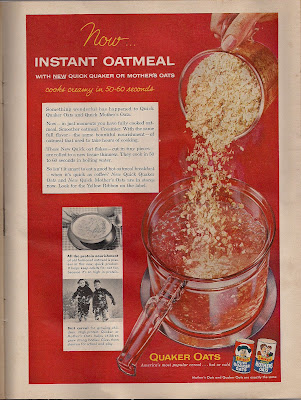
Now you know when instant oatmeal was invented–1955! Also, the picture is too small to see it (darned Picassa), but Quaker Oats used to also make “Mother’s Oats” which had a picture of a mother with her son on the canister, pictured to the right of the Quaker Oats container we still see today.


I wonder when Kellogg’s got the idea that putting the word CONSTIPATED in bold black letters at the top of their Allbran ad wasn’t the best way to appeal to someone’s appetite?


Karo makes it “extra good?”  Well, isn’t that swell!


This is one part of history I’ll happily leave behind!

Butterscotch-Toffee Chocolate Cake

Posted on

Kim, Krista, & Pillsbury inspired this recipe.  Kim posted a “Butterfinger Cake” recipe on her MySpace blogrecently, which reminded me of the cake my friend, Krista, made for her birthday last year (she used toffee instead, along with a different kind of cake).  Then I found a recipe on the side of my German Chocolate Cake mix that was basically Kim’s Butterfinger cake but with caramel instead of butterscotch.  I figured all these similar recipes was a sign that meant I was to make the cake and FAST.  So I did.

And it was good.

I will post the recipe I made up, then put the Pillsbury recipe below it since that one is probably better.  Guess it depends on what kind of flavors you prefer!  If you love butterscotch, you will love this cake.

Butterscotch-Toffee Chocolate Cake

1 German Chocolate cake mix (I used Pillsbury)
1 (20-oz) bottle butterscotch ice cream syrup (I used Smuckers)
1 8-oz container Cool Whip
1/2-3/4 of a bag Heath bits (or you can chop up several candy bars)
Chocolate ganache or chocolate fudge ice cream topping to drizzle on top
Reserve ½ cup of butterscotch syrup & set aside.

Prepare cake according to package directions in a 13×9 pan (my picture shows a small pan b/c I chose to make two small cakes so I could give one away).  Squirt 1/2 cup of the butterscotch syrup out and set aside.  As soon as the cake’s out of the oven, poke it all over with a fork and squirt what remains of the bottle of butterscotch syrup over the top, spreading with a spatula so it can absorb while the cake cools.

Fold the ½ cup reserved syrup into the cool whip and spread over the cake once it is COMPLETELY cooled.  Sprinkle Heath bits over the top and drizzle with ganache or fudge topping.  Keep refrigerated until serving.

*Veronica’s notes: the reason I left out the sweetened condensed milk is that I used syrup instead of the thick ice cream topping and figured it was thin enough to soak into the cake without adding the milk.  I would recommend using the thicker butterscotch topping in a jar & mixing it with sweetened condensed milk (like in the recipe below) b/c it only soaked in partially and there’s a thin layer of syrup resting on top of the cake still, a day later.  Of course, that could be b/c I poked it with a fork instead of making big unsightly holes with a wooden spoon as directed below, but I couldn’t bring myself to uglify the cake that way, even if it was going to be covered up.  I’m weird.  Either way, you’re probably better off following Pillsbury’s instructions vs. mine.  The cake is still REALLY good (so good my gut is about to burst from overeating it), but if you want all that gooey butterscotch really soaked in well, don’t follow my directions.

PILLSBURY® CHOCOLATE CARAMEL WOW

1 18.5 Pillsbury® German Chocolate Cake Mix
1 12-ounce can sweetened condensed milk
1 jar Smucker’s® Caramel Topping
1 8-ounce tub Cool Whip®
2 to 4 chopped Butterfinger® candy bars

Bake cake in 13×9-inch pan as directed.
Cool for 5 minutes.

Using the handle of a wooden spoon, poke holes in the cake.
In a small bowl, mix condensed milk and caramel topping, reserving 1/2 a cup.
Pour remaining caramel mixture over cake; cool completely.
Place whipped topping in medium bowl and fold in remaining caramel mixture.

Spread evenly over cake.
Sprinkle with chopped candy.
Cover loosely and refrigerate until served.
Store leftovers in refrigerator.